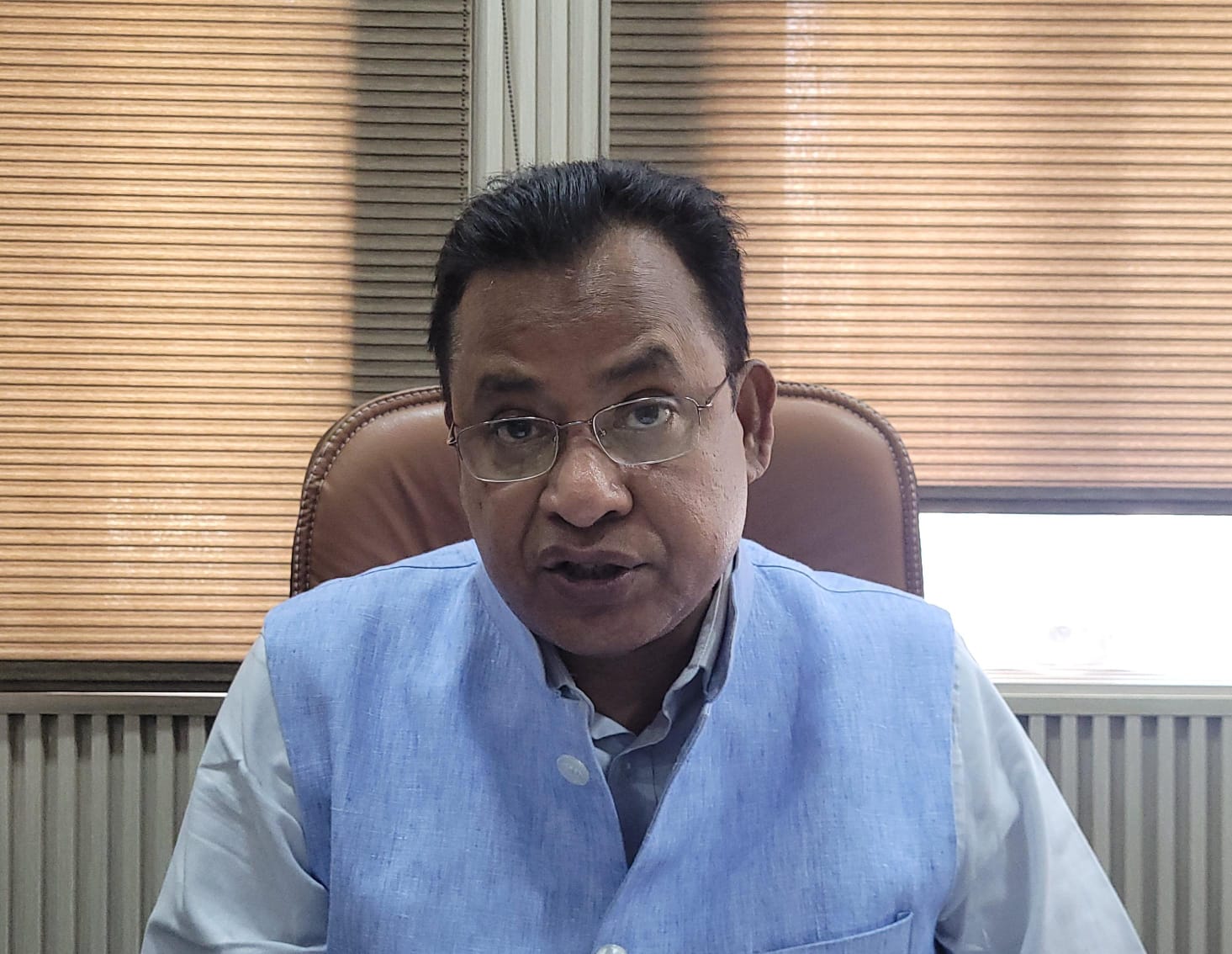

Member of Parliament from Shillong Parliamentary constituency and Voice of the People Party leader Ricky A.J. Syngkon has suggested a cadastral survey as a crucial intervention to settle property boundaries, resolve land disputes, regulate land use, streamline development, improve property taxation, and strengthen land registration and administration.
Delivering address at a national seminar on “Land, Development and Livelihood in Meghalaya” organised by the Department of Political Science, North-Eastern Hill University at U Kiang Nongbah Guest House, Syngkon underscored that a cadastral survey is not merely a technical exercise but a governance imperative for legal certainty and sound land management.
It may be mentioned that a cadastral survey is a precise, legally governed method of mapping and documenting land parcel boundaries to determine property lines, dimensions and ownership, forming official records essential for taxation and secure property rights. Stressing that land in Meghalaya is far more than an economic asset, Syngkon told the gathering, “For us in Meghalaya, I would say that land is not simply an economic resource. It is a foundation of our culture, the symbol of our identity and the bond that ties our community together. Therefore to lose land is not just to lose property, it is to lose a part of who we are.” He reminded that the Sixth Schedule was secured with this very understanding to protect tribal rights for future generations.
While acknowledging the inevitability of development, Syngkon warned that progress must not erode the state’s ecological and cultural wealth. “This progress or development, whatever type of development that we are talking about, should never come at the cost of our forest, our rivers and of course, our fragile ecology. And our natural wealth is very much part of our collective inheritance. Once it’s lost it cannot be brought back,” he asserted.
Referring to the Meghalaya Transfer of Land Regulations Act, 1971, he described it as a visionary safeguard. “This act was a landmark measure to prevent alienation of tribal land going to a non-tribal… Yet, I would say that its spirit remains invaluable. It reminds us that development must never come at the cost of identity. And what we need today, therefore, is to strengthen this law and also adapt it to the new reality,” he said.
Raising concerns over intra-tribal land alienation driven by market forces, Syngkon pointed out growing inequality within the tribal community. “One of the growing challenges that we face today is not really from outside, but I would say it’s from within… wealthier members of our own community [are] acquiring more land and in most cases at the expense of the poor and the marginalised people,” he said. He cited cases of land being bought cheaply, sometimes through outsiders marrying into tribal families, and later sold at exorbitant prices, including to the government and private companies. Such practices, he cautioned, “weaken our social fabric and risk concentrating wealth and power in the hands of few.”
Calling for collective reflection, he suggested, “Maybe a cadastral survey, which can be carried out as an intervention, that will help in terms of property boundary definition, land dispute resolution, land use planning and developments, property taxation, land registration and administration, etc.”
Highlighting the strain on traditional systems of collective and clan-based land ownership, Syngkon urged renewal rather than abandonment. He emphasised that the surge of the market economy has altered perceptions of land. “Land I would say is no longer a base for livelihood, but it has been treated as a commodity and this is dangerous… if the market forces are allowed to dominate without restraint, I say that we risk losing the very uniqueness of this beautiful state of Meghalaya,” he warned, stressing that policy must balance growth with cultural preservation.
Syngkon also underscored the inseparable link between land and livelihood, especially for rural communities. Citing government data, he noted that over 70 percent of the state’s population depends on agriculture, yet Meghalaya ranks 33rd out of 34 States and Union Territories in food security, with “around 76 percent of our farmers… actually landless.” He cautioned that rising alienation will harm the weakest sections and said policies must “ensure access to land for the most vulnerable… while creating space for innovation and opportunity for the youth of today.”
Urging scholars and policymakers to reflect deeply, the MP concluded that decisions taken today will shape Meghalaya’s identity and future. He emphasised that by “strengthening laws, addressing some of the internal challenges, renewing collective system, managing market pressure wisely, and also safeguarding both our ecology and our age-old tradition, we can walk a path where developments and identity they move together.”