
SHILLONG, June 2: Meghalaya Chief Minister Conrad K. Sangma on Tuesday informed that more than 1.5 MW of solar power capacity has already been installed in nearly 700 schools across the State under the CM Solar Mission, while implementation in another 1,300 schools will commence shortly, with nearly 2,000 government schools identified for phased installation of solar energy systems as part of Meghalaya’s expanding renewable energy push.
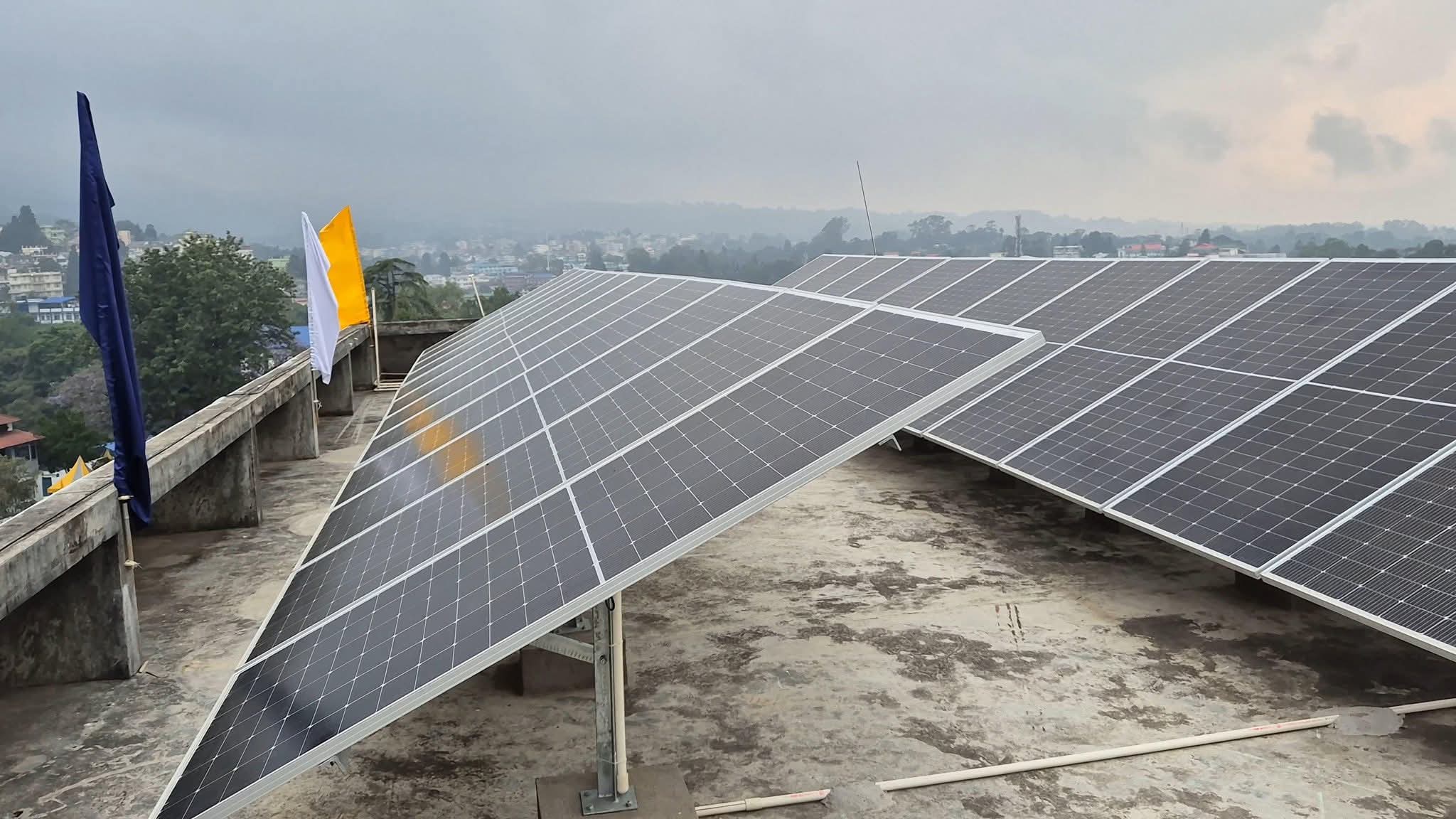
The announcement came after the Chief Minister inaugurated a 50 KW Solar Photovoltaic (PV) Plant at St. Mary’s Higher Secondary School, Shillong, under the Chief Minister’s Solar Mission. Implemented by the Meghalaya New and Renewable Energy Development Agency (MNREDA), the project is among the largest solar installations in an educational institution in the State. The system, valued at approximately ₹50 lakh, is equipped with battery backup facilities and is expected to substantially meet the institution’s energy requirements through clean energy. Stressing the urgency of accelerating the transition towards renewable energy, Sangma said, “Renewable energy is no longer just an idea—it is the need of the hour.” He added, “While technologies exist for us to solve many problems, technology by itself is not enough. What matters is whether we are able to convert that technology into a solution.” Referring to the design of the CM Solar Mission, he said the initiative focuses on complete energy solutions by integrating solar panels with inverters and battery storage systems to ensure reliability. Highlighting the newly inaugurated project, he said, “Even when there is no sunlight, the stored energy can provide backup for several days. That means if it rains continuously for two or three days, the school can still rely on the stored power.”
The Chief Minister said the solar installation is expected to save the school nearly 6,000 units of electricity every month, resulting in savings of about ₹40,000 monthly and close to ₹5 lakh annually. He also announced plans to integrate such projects with net metering systems so that excess electricity generated during weekends and vacations can be supplied back to the grid. “Some village, some house, some poor family will benefit from the power generated right here in this school,” he said, adding that large-scale participation by schools could benefit hundreds of households across Meghalaya. Announcing a major State-level technology and innovation competition, Sangma said the initiative would encourage students, innovators and entrepreneurs to develop practical solutions in sectors such as energy, waste management, water supply, healthcare and agriculture. “The government will support the best ideas. We will not just reward the winners. We will fund their startups, help them implement their solutions, and support them in growing their businesses,” he said. Emphasising the scale of support envisaged, he added, “I am talking about investing crores of rupees in these ideas.” Calling for a culture of innovation, he said, “I want innovation to become a culture in Meghalaya.”
In his special address, Dr. Joram Beda, Commissioner and Secretary, Power Department, said recent global developments have reinforced the need for energy security and a faster transition towards renewable sources. Highlighting Meghalaya’s renewable energy potential of nearly 14.6 GW, he said solar energy is emerging as a key pillar of the State’s clean energy strategy. “Projects such as this one are a true reflection of our commitment to transforming potential into reality. Through the Chief Minister’s Solar Mission, we are working to bring clean energy to every classroom and every community,” he said, adding that nearly 2,000 government schools across Meghalaya have been identified for phased installation of solar energy systems. Earlier, Sr. Sonia Chacko, Principal of St. Mary’s Higher Secondary School, described the project as a significant milestone in the institution’s journey towards sustainable development and responsible energy use. “We hope it will inspire our students to become responsible citizens who embrace innovation while caring for the planet,” she said. The programme concluded with the Chief Minister interacting with students, school authorities and officials.


