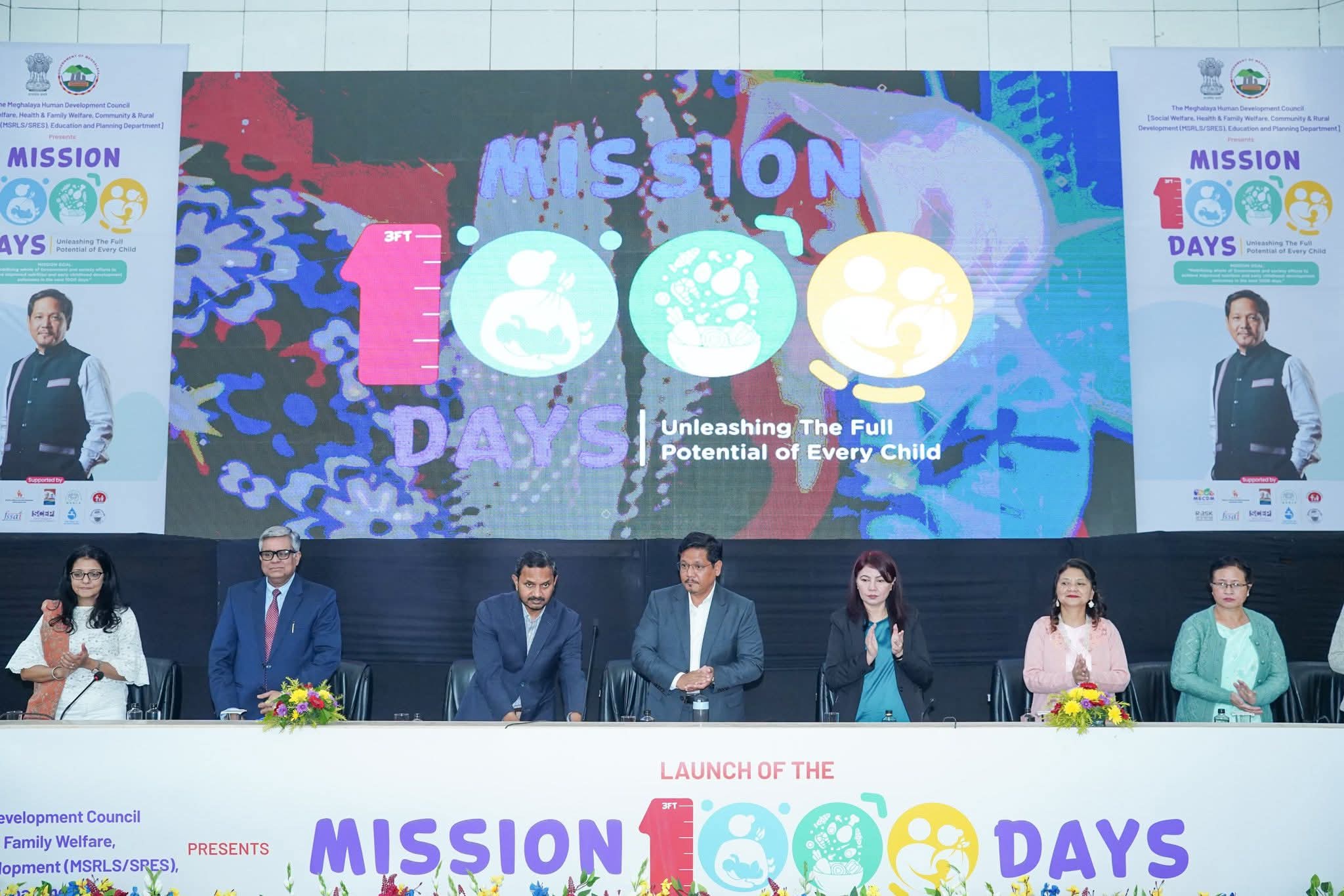
Shillong, March 31: In a major push to address malnutrition and improve maternal and child health outcomes, Meghalaya on Tuesday rolled out “Mission 1000 Days”, a mission-mode programme focused on the first 1,000 days of a child’s life, a period widely recognised as critical for physical growth and cognitive development, while signalling a shift towards a convergence-driven, evidence-based approach to human development.
Launched by Chief Minister Conrad K. Sangma at the State Convention Centre here, the flagship initiative seeks to address persistent gaps in nutrition, maternal care and early childhood development through coordinated interventions across departments, improved service delivery and deeper community engagement. The programme, led by the Meghalaya Human Development Council in convergence with key departments, aims to institutionalise a preventive and holistic framework while building on the State’s recent gains in reducing maternal mortality.
Addressing the gathering, Sangma underscored the urgency of tackling maternal health challenges, recalling the government’s early priorities. “When I took office in 2018, one of the first issues that deeply concerned me was the high maternal mortality rate in Meghalaya. It troubled not only me but the entire team, and we resolved to do everything possible to bring it down,” he said.
He noted that sustained and targeted interventions had yielded measurable outcomes. “Through sustained efforts over three years, we were able to significantly reduce maternal mortality—by nearly 50%,” he said.
Positioning Mission 1000 Days as a critical next step, the Chief Minister emphasised the need for prioritisation in governance. “What we are trying to do instead is focus on resolving 60–70% of the most critical issues,” he said, adding that large-scale interventions can significantly improve overall development indicators.
Highlighting socio-economic challenges, he pointed to the vulnerability of mothers in rural areas. “Many mothers, due to extreme poverty, are forced to return to work within a month or two after childbirth. They do not want to leave their infants, but they have no choice,” he said.
Placing the initiative within the State’s broader development trajectory, Sangma stressed the need to balance economic growth with social outcomes. “As we pursue economic growth, we must ensure that it is balanced and sustainable. Our progress will mean nothing if we fail to protect our environment, care for our mothers and children, and provide basic services at the grassroots level,” he said.
He also highlighted behavioural aspects linked to nutrition and health. “We must understand what to eat, when to eat, and how to eat. Every snack, every processed food item we consume has an impact on our health,” he said.
On the programme’s implementation, he said ₹127 crore has been earmarked to support nutritional interventions, awareness, training and essential kits for mothers and newborns. “This is a mission mode programme. We will continue to refine and improve it based on feedback, with the goal of eliminating stunting and malnutrition,” he said.
Calling for collective responsibility, the Chief Minister stressed that the initiative must evolve into a broader societal effort. “This mission cannot succeed through the efforts of a single department or individual. It requires collective participation from the entire society,” he said.
Encouraging wider engagement, he added, “Do not think that you cannot contribute. Every individual can make a difference. This must become a people’s movement.”
He also highlighted the role of fathers in early childhood development. “Fathers must participate actively in caregiving,” he said, adding, “Spending 20–30 minutes a day with a child—talking, playing, simply being present—can significantly influence their development.”
Addressing frontline workers, he urged them to view their responsibilities beyond routine duties. “Do not treat this as a job or duty. Measure your success by the lives you improve—by every mother saved and every child given a healthier future,” he said.
Officials said the mission will prioritise last-mile delivery through frontline health and nutrition workers, complemented by capacity-building measures, behaviour change campaigns and community-based nutrition interventions. The programme will also leverage technology for real-time tracking of mothers and children, enabling timely interventions and improved monitoring.
Experts at the event highlighted persistent challenges in child nutrition, including high levels of stunting and gaps in breastfeeding practices, while emphasising the importance of early stimulation, maternal nutrition and informed feeding practices. The initiative is expected to significantly improve nutrition, health and developmental outcomes for children across Meghalaya through focused interventions during the most critical stages of early life.
Meghalaya launches Mission 1000 Days to tackle malnutrition, strengthen maternal and child health