

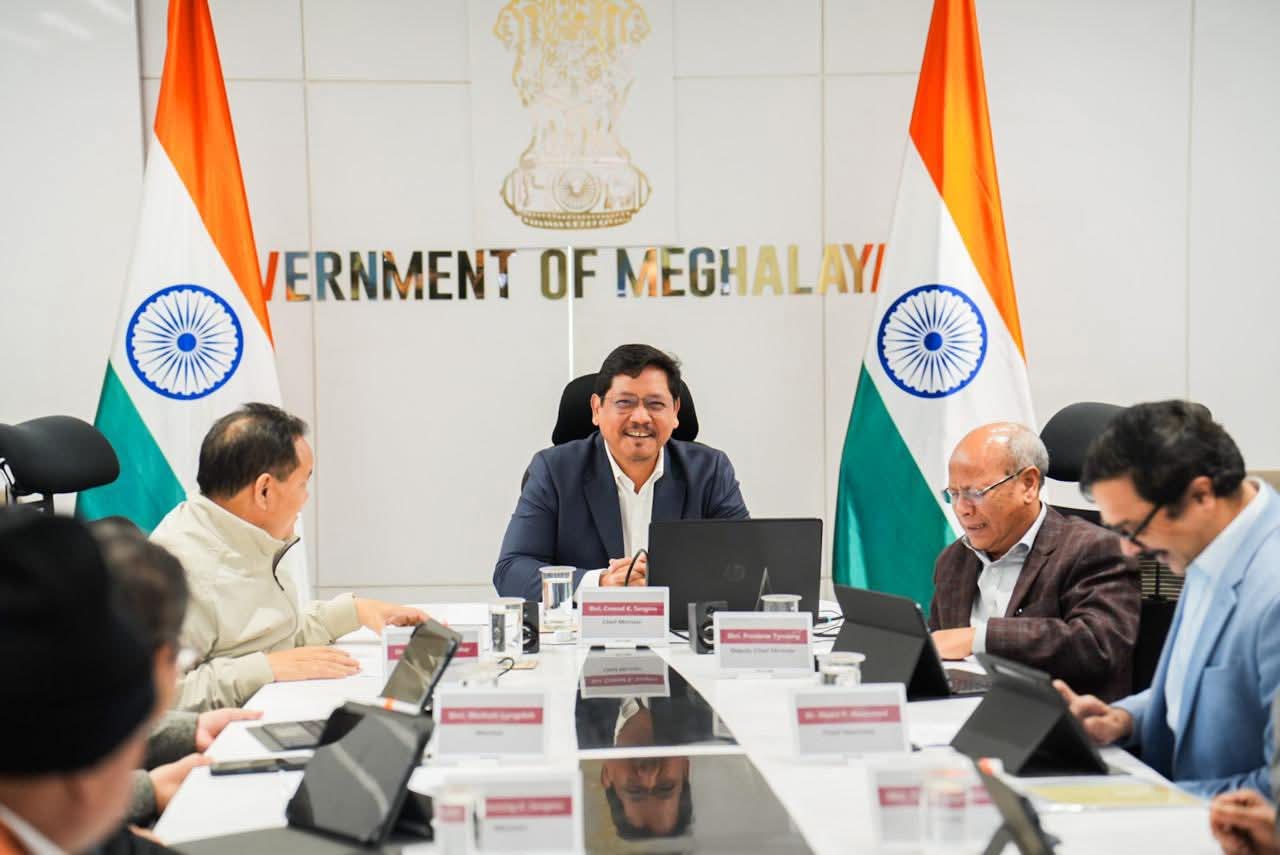
Bringing long-pending relief to thousands of non government teachers, the Meghalaya Cabinet has approved the implementation of the Meghalaya Non-Government School and College Employees Centralised Provident Fund Scheme, 2026, paving the way for structured and secure disbursal of retirement benefits to employees of aided private institutions.
A large number of employees in non-government schools and colleges had been contributing to provident funds under provisions of a legacy Act, but in the absence of a formal government-backed framework, there was no clear mechanism to manage or return these funds upon retirement.
Announcing the decision after chairing a Cabinet meeting, Chief Minister Conrad Sangma said the government has now put in place a structured mechanism to operationalise long-pending contributions and ensure benefits reach eligible employees.
Talking to media persons after chairing the Cabinet meeting in Shillong, Chief Minister Conrad Sangma said,
“The next decision that was taken, was the implementation of the Meghalaya non-government schools and college employees Centralised Provident fund scheme 2026. As you are aware that large number of non-government schools and colleges employees based on the relevant act certain contributions were being made, but government did not have a proper scheme to implement this particular contribution.”
“So today we have finalised that particular scheme and cabinet is approved it. So once this scheme is approved based on the scheme, the employees of the non-government schools and colleges, they will be getting the benefits of the Provident fund,” Sangma said.
“So today what we did was we approved that scheme, that this is how it will be given and that was something that was pending for a long time and that is what we have done,” he added.
He explained that the scheme formalises the process through which provident fund benefits will be delivered to staff of deficit institutions — private schools and colleges receiving grant-in-aid from the government — where salaries are supported under the deficit system.
The institutions covered include deficit colleges and schools where contributions had been deducted from employees under an Act adopted from the Assam era, but without a corresponding framework to regulate disbursement.
The chief minister noted that while contributions were regularly made, the absence of a structured mechanism had left uncertainty over how the accumulated funds would be returned to employees after retirement.
The CM indicated that while exact beneficiary numbers were not immediately available, the scheme is expected to primarily cover college and school teachers working in deficit institutions across Meghalaya.