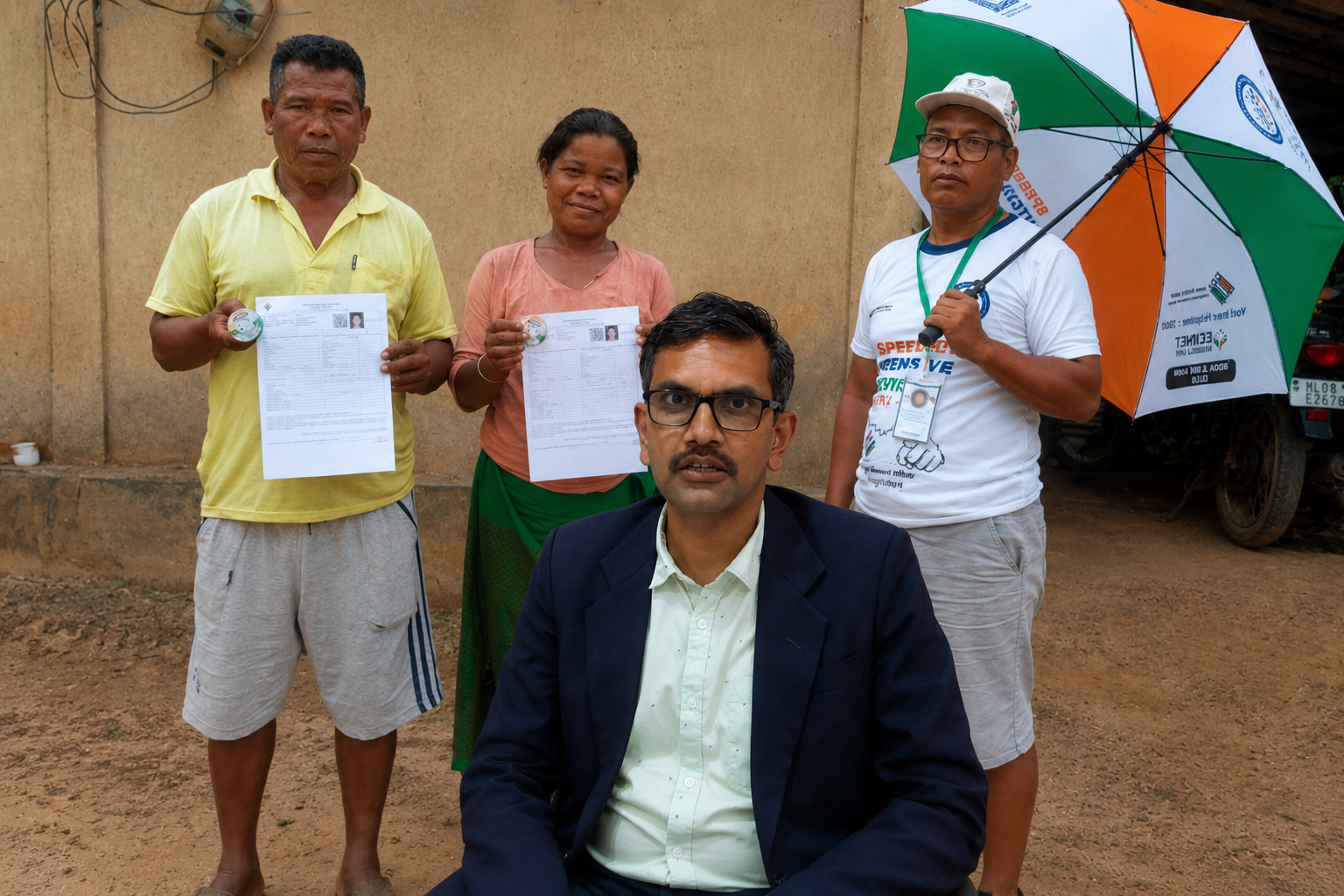
Meghalaya has achieved nearly 85% coverage in the distribution of Enumeration Forms under the Special Intensive Revision (SIR), 2026 of the Electoral Roll, marking steady progress in the Election Commission of India’s drive to ensure an accurate, inclusive and updated electoral roll. The exercise has also gathered pace in the digitisation of forms, with election authorities intensifying monitoring and voter outreach across the State.
Chief Electoral Officer BDR Tiwari on Tuesday said the revision exercise continues to witness encouraging progress through the concerted efforts of the election machinery and the active cooperation of electors. As of 9.58 a.m. on July 14, Enumeration Forms had been distributed to 19,91,883 of the State’s 23,49,645 registered electors, achieving 84.77% coverage. A total of 5,64,610 forms have also been digitised, accounting for 24.03% of the total electorate.
West Jaintia Hills has recorded the highest Enumeration Form distribution at 98.94%, followed by South West Garo Hills (97.77%), North Garo Hills (95.12%), South West Khasi Hills (90.37%) and East Garo Hills (88.84%). In digitisation, East Jaintia Hills leads with 41.55%, followed by South West Khasi Hills (40.31%), Eastern West Khasi Hills (36.73%), South West Garo Hills (34.01%) and West Garo Hills (33.23%).
To strengthen public participation, the Office of the Chief Electoral Officer conducted an awareness and interaction programme on the Special Intensive Revision with members of the Meghalaya Legislative Assembly in hybrid mode at the MLA Hostel Conference Hall in Shillong on July 13. During the interaction, the objectives, significance, timelines and procedures of the exercise were explained while legislators were urged to encourage eligible citizens to actively participate in the revision process.
Highlighting the monitoring mechanism, Tiwari said, “To ensure effective monitoring and timely implementation of the Special Intensive Revision, I have been conducting weekly video conferences with the District Election Officers (DEOs), Electoral Registration Officers (EROs) and Assistant Electoral Registration Officers (AEROs). During these review meetings, the progress of house-to-house distribution of Enumeration Forms, digitization of Enumeration Forms, and other activities under the SIR programme is reviewed in detail. The officers have been instructed to closely monitor the work of the Booth Level Officers (BLOs), promptly resolve issues at the field level, and ensure that all activities are carried out smoothly and completed strictly within the timelines prescribed by the Election Commission of India.”
The Chief Electoral Officer appreciated the efforts of the District Election Officers, Electoral Registration Officers, Assistant Electoral Registration Officers, Booth Level Officers, BLO Supervisors and all election officials for ensuring the successful implementation of the revision exercise across Meghalaya.
Appealing to voters to complete the process without delay, Tiwari said, “Once the pre printed Enumeration forms already been distributed we through the BLOs we request all the electors who recieved the enumeration forms they should fill respective information in the prescribe columns and submit that to the BLO. The electors are suppose to take the recieving copy from the BLO. BLO is suppose to digitised all these forms, through BLO app.”
Addressing queries from voters staying outside Meghalaya, he said, “One common query coming from people like if a person if not present at the time of BLO visit, or stays outside the state like students or patients who have gone out of the state for treatment or for employment, they can fill the form online. So the online filing of form facility is also available for all electors of the state and they can fill the form by downloading ECI net app or they can login in the portal. In respect to getting the details of the relatives in the previous SIR which states as on 1.1.2005, so the Electoral roll of 2005 is available in the district website and CEO website also they can download or they can excess through ECI net or the portal, and they can get details of the relatives and fill the form. As well as BLOs has access to all the details. So BLO are helping the electors to fill the forms properly. So with the right information the filed enumeration forms to be collected by BLOs.”
Explaining the requirements for electors whose names do not appear in the 2005 electoral roll, Tiwari said, “Those whose names are not mentioned in 2005’s voters list, if they have become electors after 2005, so their parents names might be there in 2005 SIR, so they have to give details of either mother or father or grand parents as case may be applicable. So there are the three columns, so in first column who are the electors in 2005, his or her name in 2005 SIR they should give their details. Secondly along with them they can give their relatives names also, but that is not mandatory if their names are already found. If the persons names are not there, parents name is there they can give the details of their parents in the previous SIR at 2005 Electoral roll in the state. There might be the cases where not found in the both parents details and their details, they can give all their details in the third column and they can atleast submit at the time of the claim and objection one of the identity proof out of 11 documents already been prescribed by the election commission of India. If no one is there in 2005, if they are present day electors in the state, they can give all their details in the third column.”
The Chief Electoral Officer urged electors who have not yet received or submitted their Enumeration Forms to cooperate with Booth Level Officers during house-to-house visits or seek assistance from their respective BLOs. He appealed to all eligible voters to actively participate in the Special Intensive Revision, 2026 to ensure that every eligible citizen is included in the electoral roll, thereby strengthening the democratic process and upholding the principle of inclusive and participative elections.