
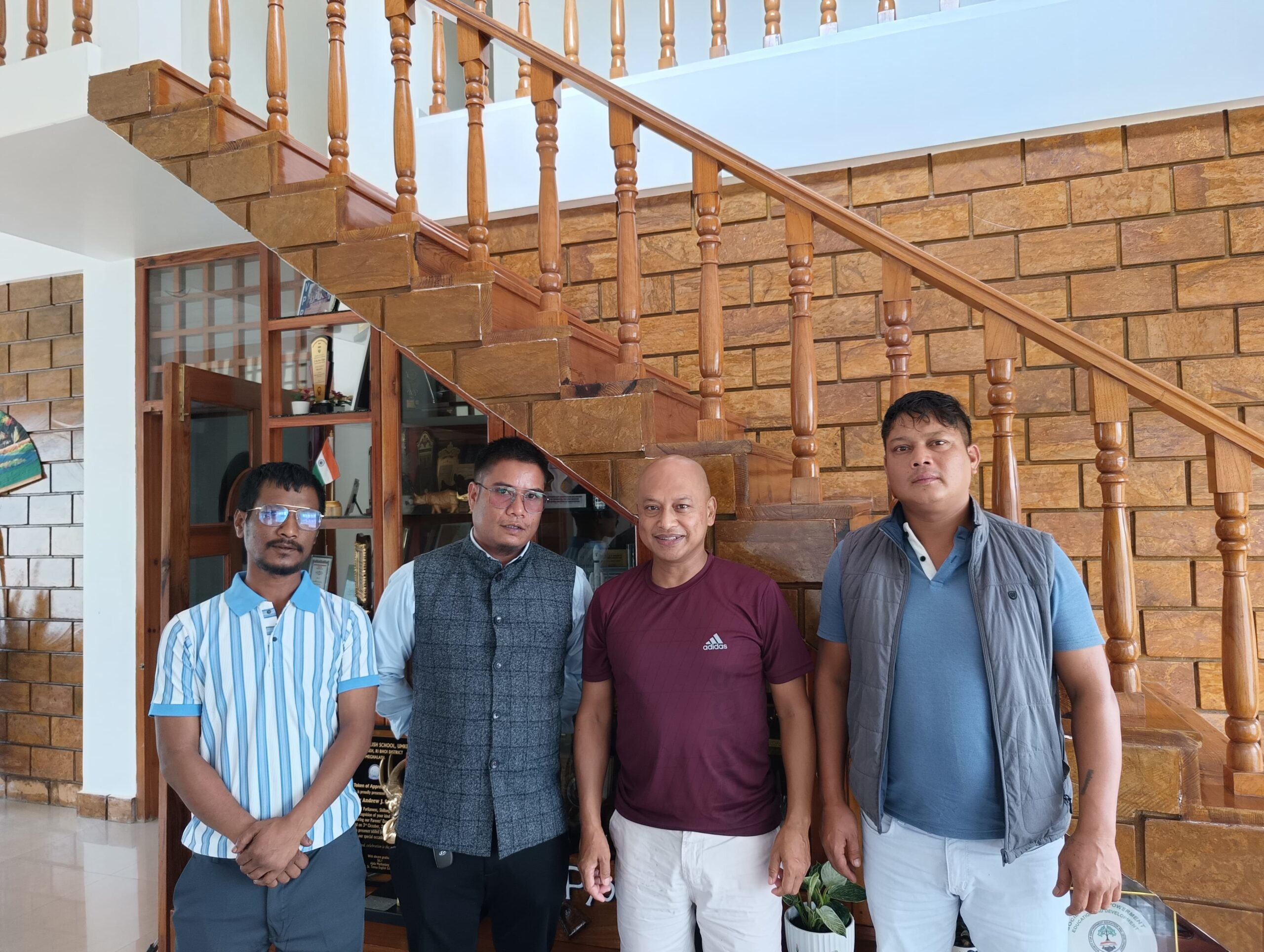
Shillong, October 7: The Jaiñtia National Council (JNC) has submitted a memorandum to Shillong MP Dr. Ricky AJ Syngkon, urging his immediate intervention over the alarming delay and substandard construction of National Highway 6 (NH-6) in the Jaiñtia Hills region of Meghalaya.
In its detailed representation, the JNC — a socio-political pressure group advocating the rights and welfare of the Jaiñtia people — expressed deep concern over what it described as “administrative inefficiency, poor project management, and neglect of public safety” in the ongoing highway construction.
The project, sanctioned in hundreds of crores of rupees, was expected to transform the region’s connectivity and economic prospects. However, the Council stated that the “ground reality has been disappointing and far from satisfactory.”
According to the memorandum, the National Highways Authority of India (NHAI) had been directed by the Hon’ble Meghalaya High Court to complete the project by August 2025, but as of October 2025, “the work remains incomplete.” The JNC alleged that this failure to meet the Court’s timeline, despite the absence of major topographical challenges in stretches like Wahiajer to Jowai, has resulted in daily traffic jams, loss of working hours, and mounting commuter frustration.
The Council also raised concerns over the “poor performance and mismanagement” by two contractors — Purbanchal Buildtech Pvt. Ltd. (Jowai Bypass to Wahiajer) and Dhar Construction Company Ltd. (Wahiajer to Ratacherra). It accused Purbanchal Buildtech of “gross negligence, repeated delays, and substandard construction,” and called for the company’s performance to be “thoroughly reviewed by MoRTH” and for it to be “considered for blacklisting.”
The memorandum further pointed to serious design and structural flaws, including the “narrowing of the new NH-6 compared to the old highway,” which the JNC said was “inappropriate for a national highway handling heavy and commercial traffic.” The Council described the move as “a poor design choice that restricts future expansion and poses serious safety risks.”
Adding to the list of grievances, the JNC criticized the use of “concrete cement pavement in a high-rainfall and hilly terrain,” calling it unsuitable for the region’s climatic conditions. It noted that “visible cracks, uneven surfaces, and water damage” have already appeared in several newly constructed sections, especially near Khliehriat, indicating “the use of inferior materials and inadequate quality control.”
The Council also highlighted the “absence of a proper drainage system,” warning that poor water management could cause erosion, flooding, and rapid road deterioration during monsoons.
In its appeal, the JNC urged Dr. Syngkon to raise the matter before the Ministry of Road Transport and Highways (MoRTH) and press for accountability from both NHAI and the contractors involved. It also sought a “special inspection and technical audit” of the project, along with “disciplinary and financial action” against those responsible for negligence or corruption.
“The people of Jaiñtia Hills had placed great hopes on this project, but the current execution has only brought frustration and hardship. A safe, durable, and efficient highway is not only a developmental necessity but also a matter of public rights and justice,” the memorandum stated.
In response, Dr. Ricky AJ Syngkon assured the delegation that he would “address the issue with seriousness.” He also indicated that he would personally inspect the road and take necessary measures to ensure accountability, welfare, and long-term infrastructural improvement for the Jaiñtia people.