

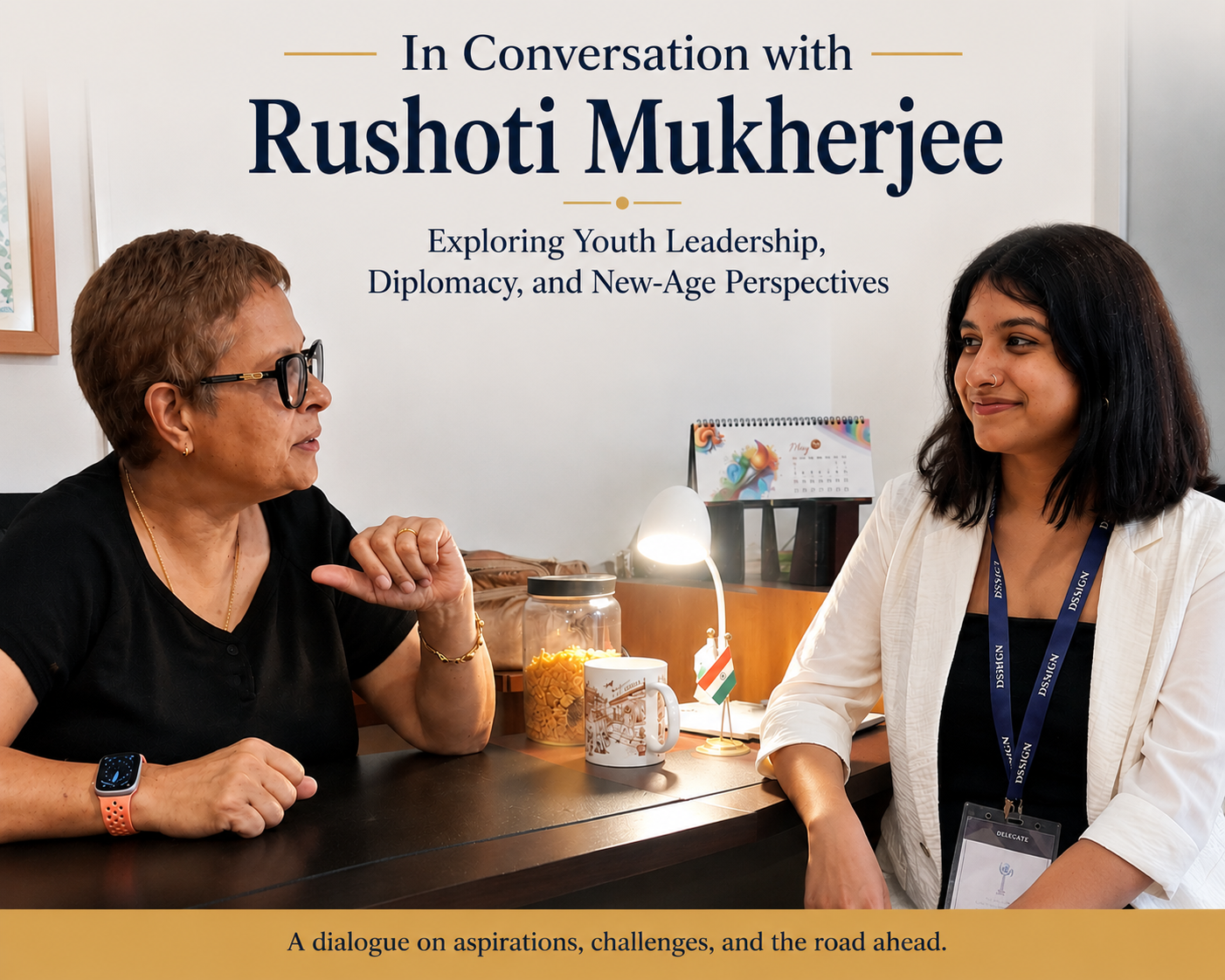
In Conversation with Rushoti Mukherjee
As the Cockroach Janata Party (CJP) gains visibility through political satire and social media engagement, conversations around youth participation in Meghalaya’s political landscape have taken centre stage. In a recent sit-down interview, MLA Ampareen Lyngdoh shared her views on unemployment, youth aspirations, political engagement, and what she sees as a growing accountability gap in the digital age.
While many young people are increasingly using online platforms to express political frustrations and concerns, Lyngdoh argued that some of the challenges facing the state stem from changing attitudes towards work and employment.
“Easy” Way Out and Shillong Comfort Zone
When asked about concerns surrounding unemployment and examination irregularities in a state where 73% of the population is between 18 and 35 years old, Lyngdoh said the issue cannot be attributed solely to the government.
“I beg to differ to say that there is unemployment,” Lyngdoh stated. According to the MLA, employment opportunities exist, but many young people remain selective about the kind of work they are willing to undertake. “People are not taking compulsory choices in options for employment. They only want a certain kind of a job. They only want a certain perceived salary… By definition, you’ll not get a job.”
According to Lyngdoh, there is a “huge vacuum of skilled individuals” in manual labour and trade-based professions. “Nobody wants to wake up at 7 AM, rush to a construction site, engage in construction work. Nobody wants to do plumbing, nobody wants to do electrical work,” she noted. She cited examples of young engineers declining opportunities located just 60 kilometres away, saying, “I’m not going, I want to sit in Shillong.”
For Lyngdoh, the challenge is not merely the availability of jobs, but the willingness to consider opportunities outside preferred sectors and locations.
CARROTS, COWS, AND “FLASHY LIFE”
The contrast between generations emerged as a recurring theme throughout the conversation. Lyngdoh reflected on earlier generations that grew their own food and maintained stronger connections with agriculture and livestock.
“Today, which child is willing to plant even one carrot?” she asked.
She argued that sectors such as agriculture and animal husbandry, despite their economic potential, struggle to attract younger participants because of the long-term commitment they require. “Nobody wants to tend to a cow for 15 years before any substantial or tangible income output,” she remarked.
Lyngdoh also suggested that consumer aspirations have become increasingly influential among younger generations. “In this generation, our people are understanding it: flashy life, fancy clothes, fancy phones,” she observed. “Can any young person live without a fancy phone? I doubt it.”
CJP, ZERO ACCOUNTABILITY, AND “BASHING POLITICS”
Addressing the rise of the Cockroach Janata Party, Lyngdoh acknowledged that political satire and alternative forms of political expression are not unique to Meghalaya, noting that younger generations are engaging in politics through methods that are often less confrontational than those seen historically.
At the same time, she expressed concerns about the nature of online discourse and accountability on social media platforms, arguing that anonymity often weakens responsibility for public statements.
“I want to say something in the media, I’ll just say it, I don’t care,” Lyngdoh said, mimicking what she described as a common attitude among some digital users.
She was also critical of what she termed “fly-by-night parties,” arguing that criticism alone cannot substitute for governance. “Let’s bash everyone, promise the world… but it’s not easy,” she said.
Missing ‘Stick’ and Trust Deficit
Lyngdoh also spoke about what she believes is a broader shift in parenting and discipline across generations.
“When we were kids, we were never spared the rod. Parents had a stick waiting. Any child that misbehaved would get a whacking,” she recalled.
According to Lyngdoh, changing family dynamics have reduced parental authority, contributing to behavioural challenges that later manifest in society.
She linked this to what she described as a growing trust deficit between institutions and sections of the youth population. Referring to government assistance schemes, she alleged that some beneficiaries readily accept subsidies and loans but fail to meet repayment obligations, ultimately undermining institutional support mechanisms.
Ultimately, Lyngdoh cautioned against what she sees as increasing individualism among younger generations. Contrasting it with what she described as a stronger sense of collective responsibility in earlier public life, she criticised attitudes that prioritise personal interests over broader social obligations.
“My salary is just for me and my family. I’m sorry if somebody died, oops, I’m sorry,” she said, describing what she believes is an increasingly common mindset.
Whether Meghalaya’s youth and its political leadership can bridge these differences remains an open question. What was clear from Lyngdoh’s remarks, however, is that she sees the debate as extending beyond employment and politics to larger questions of responsibility, discipline, and civic participation.