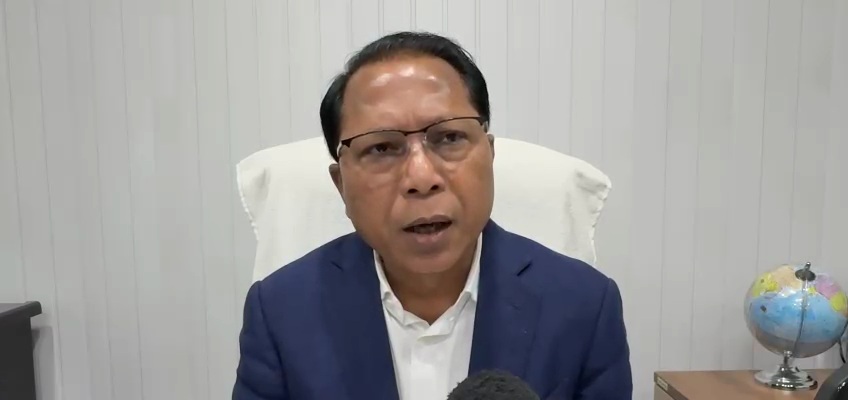
Former Meghalaya Chief Minister and Leader of Opposition in the Meghalaya Legislative Assembly Mukul Sangma has launched a strong attack on the State government over the proposed amendment to the Meghalaya Residents Safety and Security Act (MRSSA), questioning why a legislation that, according to him, was framed after extensive consultations and deliberations on illegal immigration and uncontrolled influx needed to be altered. Sangma argued that the original legislation had been carefully crafted within the constitutional and legislative limits of the State and was intended to provide an immediate legal mechanism to address concerns over influx and illegal immigration. He alleged that altering the law in a manner that could take it beyond the legislative jurisdiction of the State legislature would effectively delay or prevent its implementation.
Sangma said the MRSSA was formulated after detailed discussions with civil society organisations and after examining the concerns raised by different stakeholders and the possible measures required to address them. Describing it as one of the best legislations, he said he had even referred to the Act at an internal security meeting and suggested that other States and countries facing the challenge of uncontrolled illegal immigration should study the Meghalaya legislation. “It is, I will say one of the best legislation across the globe,” he said.
“Even I have suggested in the internal security meeting, I have referred to this MRSSA and said that this act must be studied by every state, And in fact, this act must be started also by other countries,” Sangma said, arguing that nations across the world were grappling with illegal immigration. He said Meghalaya faced the additional challenge of dealing simultaneously with illegal immigration and uncontrolled influx, making it necessary to have a legal framework that could be implemented without running into constitutional limitations.
Sangma said the State legislature had to remain within its constitutionally defined jurisdiction while framing legislation. “The moment we step Beyond the legislative jurisdiction of the state legislature, then the law will be sent to Delhi for the Ministry of Home Affairs to scrutinize and subsequently to get the ascent from the president,” he said.
According to Sangma, the original objective was to address illegal immigration and uncontrolled influx with a sense of urgency while ensuring that the legislation remained enforceable. He alleged that any amendment which introduced provisions beyond the State legislature’s jurisdiction could undermine that objective by triggering the requirement for further constitutional scrutiny. “Now the moment you temper on this piece of legislation, which was already designed to ensure its enforcement immediately, that means, indirectly, The government of the day has malafide intention of not to implement it,” he said.
Sangma further argued that even the Governor’s powers could not override constitutional procedures if a legislation crossed the limits of the State legislature’s competence. “Because they know the moment put any other cross that goes beyond the legislative jurisdiction of the state legislature than the governor cannot ascent. Even if he wants to ascent, he cannot give his ascent,” he said. “It has to be completely in line with the basic mandate of the Constitution.”
Recalling the discussion in the Assembly, Sangma said he had questioned the government over the proposed amendment and its implications for the enforceability of the MRSSA. He maintained that framing the original legislation itself had required considerable caution because even a change in nomenclature or provision could potentially take the law beyond the State’s legislative jurisdiction.
“The initial exercise itself was tightrope walk Because the moment you and any other single nomenclature you may lend up going beyond the legislative jurisdiction of the state legislature,” Sangma said.
He alleged that the government, relying on its majority in the Assembly, pushed through the amendment despite the concerns raised over its constitutional implications. “But then the house was bulldozer because they were in majority,” he said.
Sangma questioned the underlying objective of the amendment and alleged that it was intended to prevent the MRSSA from being effectively enforced. “What is the purpose?” he asked. “The purpose is to see that this law cannot be enforced.”
He concluded by accusing the government of deliberately working against the interests of the people of Meghalaya and described the move as a political and legislative attempt to prevent the State from implementing the law. “I condemned their anti people conspiracy,” Sangma said. “This was a conspiracy to ensure that MRSSA cannot be implemented.”