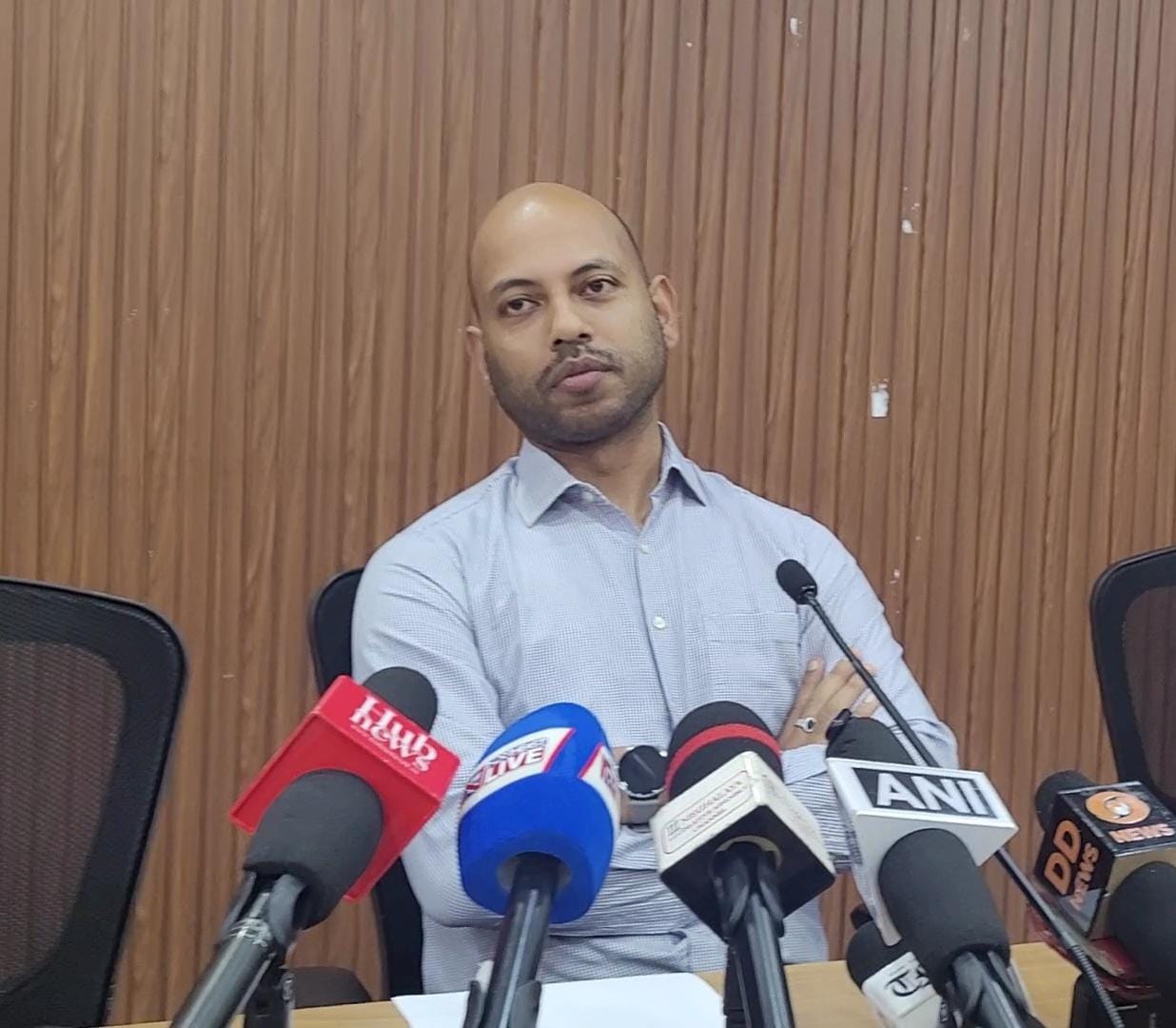

Declaring that India’s education system is in the “ICU”, the Meghalaya Pradesh Congress Committee (MPCC) on Thursday launched a sharp attack on the Union Government, alleging that repeated examination leaks, shrinking education budgets, mounting teacher vacancies and widening digital inequalities have pushed the sector into a deep crisis. The party highlighted the impact on Meghalaya, where 4,164 students were forced to reappear for the NEET examination across 14 centres following nationwide irregularities. Addressing a press conference in Shillong, MPCC Social Media Cell Chairman Langkupar War said the turmoil surrounding NEET-UG 2026 reflected a broader collapse in the credibility of India’s examination system. He noted that more than 22 lakh students appeared for NEET-UG 2026, with a success rate of just 5 to 6 per cent, only to face allegations of paper leaks and irregularities that necessitated a re-examination on June 21 across 5,440 centres in 551 cities.
“NEET decides who becomes a doctor; when its gateway is compromised, trust in the whole system is shaken,” War said. “The paper leak in NEET is not an isolated crisis but a symptom of a deeply compromised national examination system where public trust has completely collapsed,” he added.
War argued that the controversy was part of a continuing pattern that included the Supreme Court-confirmed paper leaks in NEET-UG 2024, which benefited more than 155 individuals, the cancellation of UGC-NET 2024, the postponement of CUET-UG 2026 and the re-test conducted for UGC-NET 2026 in Jalandhar. He alleged that despite the enactment of the Public Examinations (Prevention of Unfair Means) Act on June 21, 2024, examination leaks and irregularities had continued unabated. The MPCC also pointed to the Supreme Court’s criticism of the NTA in July 2026 and the arrest by the CBI of several experts appointed by the agency to prepare examination papers.
“The NTA promised ‘error free delivery’. Instead we got the NEET-UG 2024 leak that the Supreme Court said was ‘not in dispute’ with around 155 suspected beneficiaries, UGC-NET 2024 cancelled, CUET-UG 2026 rescheduled, and UGC-NET 2026 re-tested,” he said.
The Congress further accused the Centre of undermining cooperative federalism by withholding educational funds and centralising decision-making. Referring to the financial year 2024-25, the party pointed to the withholding of Samagra Shiksha funds from Kerala, Tamil Nadu and West Bengal over disagreements related to the PM-SHRI Memorandum of Understanding. War said expenditure on education stood at only 4.12 per cent of GDP in 2021-22, well below the National Education Policy target of 6 per cent. He added that the 2024-25 Union Budget reduced allocations for school education by 7 per cent, higher education by 17 per cent and the University Grants Commission by 61 per cent. The Gross Enrolment Ratio in higher education remained at 28.4 per cent against the NEP target of 50 per cent by 2035, while faculty vacancies in central universities ranged between 25 and 35 per cent.
“When public education is weakened through budget cuts, families are forced into expensive coaching systems and debt merely to secure educational opportunities for their children,” he said.
The MPCC also criticised the discontinuation of pre-matric scholarships for minority students from Classes I to VIII from the 2022-23 academic year and the scrapping of the Maulana Azad National Fellowship and Padho Pardesh schemes. It further raised concerns over the removal of chapters on the Mughal Empire and the Delhi Sultanate from NCERT Class 7 textbooks and the deletion of the Periodic Table from the Class 10 Science curriculum. Highlighting the shortage of teachers, War cited a parliamentary committee report that recorded 8,46,647 vacant teaching posts in 2023-24 and warned that vacancies were nearing 10 lakh nationwide. He said the ASER 2024 report found that only 23.4 per cent of Class 3 students in government schools could read a basic Class 2 textbook, while 1,04,125 schools were functioning with a single teacher and 7,993 schools had zero student enrolment, despite the national dropout rate declining from 10.9 per cent to 8.2 per cent.
“A country cannot speak of demographic dividend when lakhs of teaching posts remain vacant and learning outcomes continue to deteriorate,” he said.
For Meghalaya, the MPCC said the consequences of these failures were immediate and severe. A total of 4,164 students from the State were required to reappear for the NEET examination across 14 centres, including 10 in Shillong, two in Tura, one in Jowai and one at NEPA, Umiam. The party expressed concern over the proposal to make NEET fully computer-based by 2027, arguing that it could disproportionately affect students from rural and tribal regions. While 64.7 per cent of schools nationally have computers and 63.5 per cent have internet access, Meghalaya has computers in only 19.7 per cent of its schools.
“4,164 Meghalaya students re-sat NEET across 14 centres. The state depends on Samagra Shiksha at a 90:10 ratio and has among the lowest school-computer access in India. National failures land harder here,” War said.
Demanding accountability, the Congress called for the resignation of the Union Education Minister, a time-bound judicial probe into NTA and NEET irregularities from 2024 to 2026, publication of a White Paper on all examination leaks and cancellations since 2018, filling of 8.46 lakh vacant teaching posts, raising education spending to 6 per cent of GDP, protecting university autonomy, compensating affected students and holding a dedicated parliamentary debate on national testing.