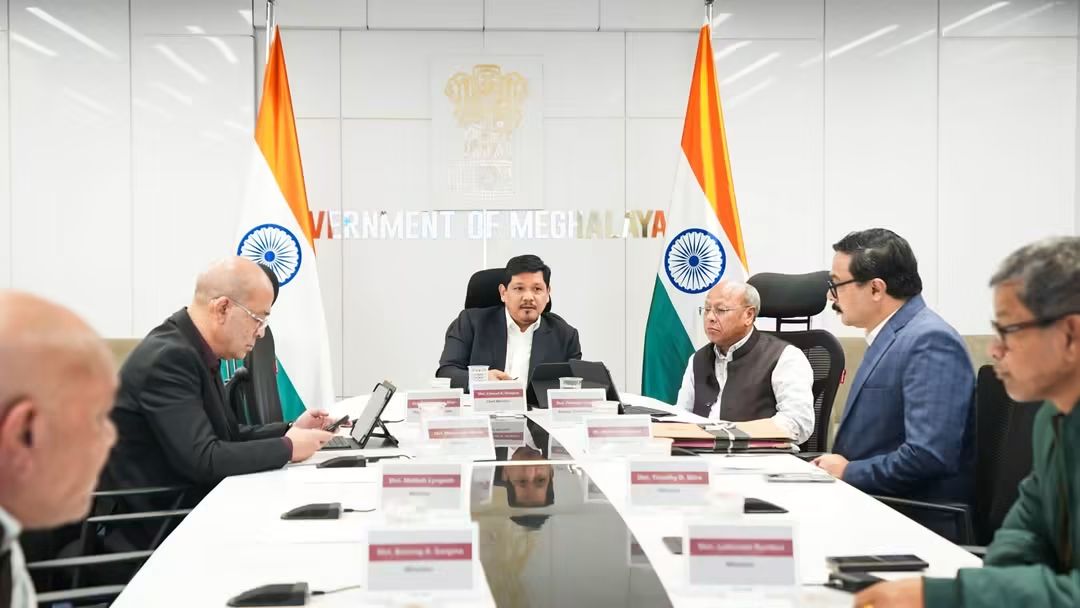
SHILLONG: The Meghalaya Cabinet has approved the Meghalaya School Education School Complex Rules, 2026, to establish a voluntary nodal school framework linking lower and upper primary schools with nearby secondary and higher secondary institutions, in a bid to address admission bottlenecks and eliminate repeated paperwork as students progress through different stages of schooling.
Announcing the decision after the Cabinet meeting, Chief Minister Conrad K. Sangma said the state’s school structure posed challenges for students, with the number of institutions declining sharply at higher levels of education. Meghalaya has 9,244 lower primary schools, 2,396 upper primary schools, 1,755 secondary schools and 532 higher secondary schools.
“This challenge in the structure of the schools leads to students not being able to get admission number one and number two is it also leads to students having to take admission two times three times during their School education procedure,” Sangma said.
Explaining the inconvenience caused by the existing system, he said students often had to complete fresh admission procedures multiple times as they moved from one stage of schooling to another.
“So, in some cases, students are taking admission once obviously in class one, then, second time in class 6, then again in class 9 and again in class 11, So it’s a very, very inconvenient process, and this is happening because of this structures that we have in the in the schools,” he said.
Under the new framework, the government intends to link lower and upper primary schools with surrounding secondary and higher secondary institutions designated as nodal schools. The arrangement is expected to facilitate transitions between classes, including from Class V to VI and Class VIII to IX, without requiring students to repeatedly complete admission formalities and submit transfer certificates.
“So, we’re trying to create nodal schools, which will facilitate the process of admission, without having to get the transfer certificate and other formalities to be completed,” Sangma said.
He clarified that the arrangement would be voluntary and would not interfere with the functioning or decision-making powers of participating institutions.
“It’s not a compulsory kind of a setup, but it’ll be done only with schools that are wanting and willing to work with us,” he said, adding that the government would approach schools willing to participate in the initiative.
The Chief Minister said the framework could eventually help the government develop a stronger network of secondary and higher secondary schools across blocks, subdivisions and districts, particularly in areas that currently lack institutions offering education at these levels.
“So this kind of exercise will allow us to work on that and also work with schools which are cooperating with us in terms of this nodal school formula in this entire structure that they are creating,” he said.
The framework is also expected to support the long-term development of nodal and model schools across the state.