
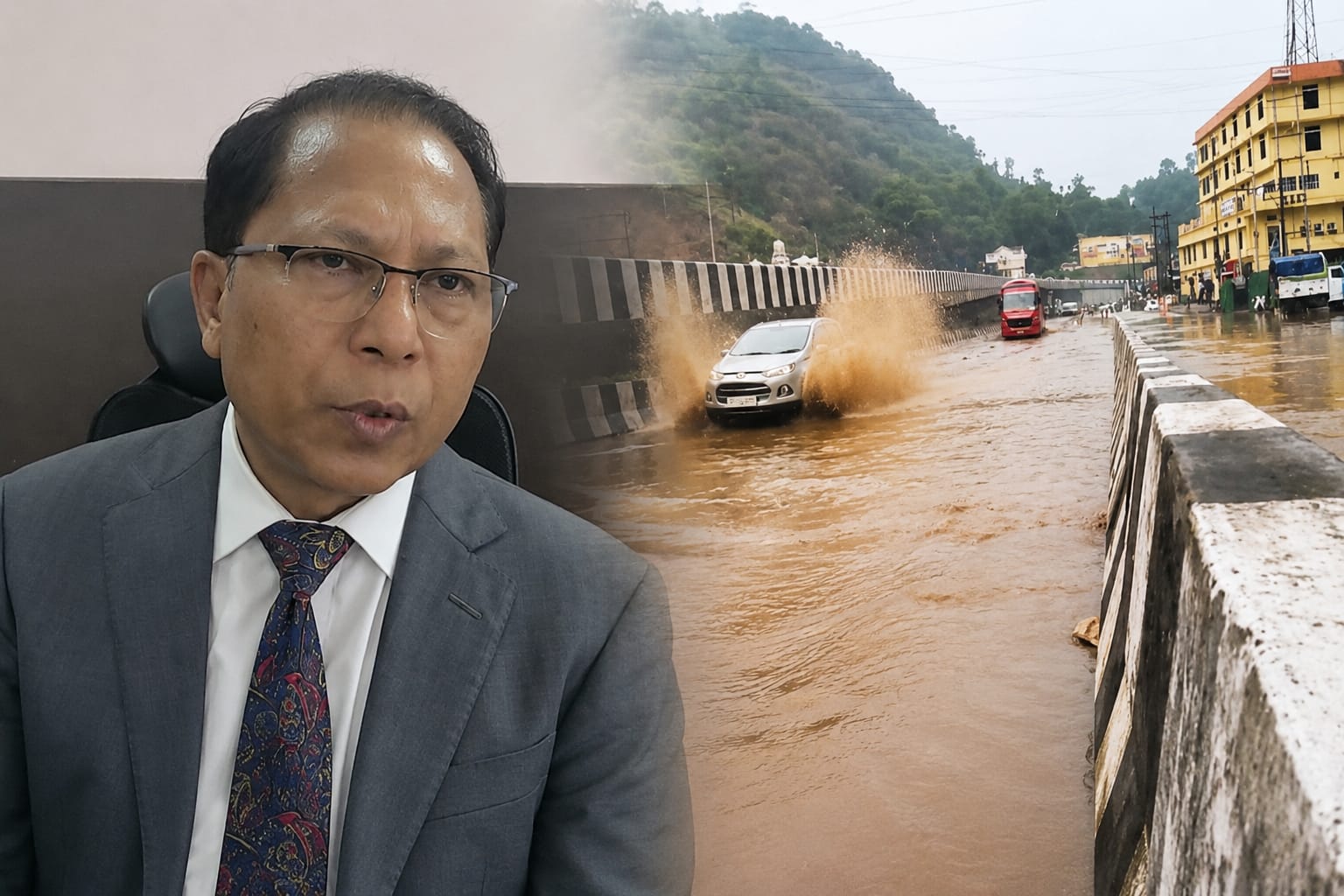
Former Meghalaya Chief Minister and Leader of the Opposition Mukul Sangma, reacting to the devastating floods in Nepal and disasters across the Himalayan region, has called for a scientific and professional approach to disaster mitigation, stringent monitoring and auditing of Detailed Project Reports (DPRs) before implementation, particularly for infrastructure in Meghalaya’s hilly terrain.
Sangma said disaster preparedness must move beyond response and focus on mitigation, with disaster risks factored into the design of infrastructure and urban development from the outset. He stressed that roads and other projects in Meghalaya must be planned to withstand anticipated risks, with DPRs rigorously audited before construction begins.
“Resilience to disaster perspective, And while building roads, for a hilly terrain like Meghalaya, the whole designing, the structural design, and everything has to be also factored in such a matter that all these disaster related issues and challenges, which are usually unforeseen but can be anticipated are appropriately factored, and at the time of drawing up this projects, all these things must be stringently monitored and also there has to be kind of auditing even before the implementation of the program. Auditing in the in respect of the DPR.”
Sangma said the Disaster Management Act, 2005, was enacted after extensive consultations and consideration of major disasters, including the 1897 earthquake, which provided important lessons on the vulnerability of the Northeast. He said the legislation envisages coordination between the Union and state governments and a comprehensive disaster-management framework.
He pointed to Meghalaya’s existing institutional structure, involving district and state disaster-management authorities and line departments, and said the framework should ensure that disaster resilience becomes an integral part of development planning.
Sangma warned that the failure to account for natural systems while expanding urban settlements was contributing to the severity of flooding in several parts of the country. He cited Delhi and Gurugram as examples of cities where rapid, high-density development has affected natural drainage.
He said natural waterways must be preserved, particularly in regions such as the Northeast, where heavy rainfall and difficult terrain increase the risks of flooding and landslides.
Sangma referred to extreme weather events in Meghalaya, including the 2014 cloudburst, and said recent developments in the Himalayan region showed that disasters were becoming increasingly unpredictable and severe.
“What is happening in Himalayan Terrain what has happen in Uttara Khan, Himachal or now in Nepal, so things are bound to come with an element of surprise, these are elements of surprise which otherwise in terms of magnitude we didn’t expect but the magnitude we are seeing today is very very alarming.”
He said the experience of Nepal, Uttarakhand and Himachal Pradesh should prompt governments, particularly in the Northeast, to revisit disaster-management and development strategies.
“Therefore, there has to be more in-depth revisit to all these approach that we have adopted and every Government has to take cognizance of this.”
Sangma said mitigation must be based on anticipating the impact of disasters on infrastructure, existing settlements and new habitations rather than merely responding after a disaster occurs.
“The mitigation part, Mitigation is not based on what is already because of the impact of disaster that has already taken place.”
He called for experts from relevant scientific and professional fields to be brought into the planning process, with policymakers guided by scientific evidence and technical expertise. He also urged authorities to identify areas where natural systems should be left undisturbed.
Sangma said urban expansion driven by migration, employment, education, healthcare and economic opportunities was inevitable, but argued that such expansion must be guided by scientific planning rather than unchecked real estate development.
He warned that even cities that receive relatively lower rainfall can face severe flooding when natural drainage channels are obstructed by unplanned construction.