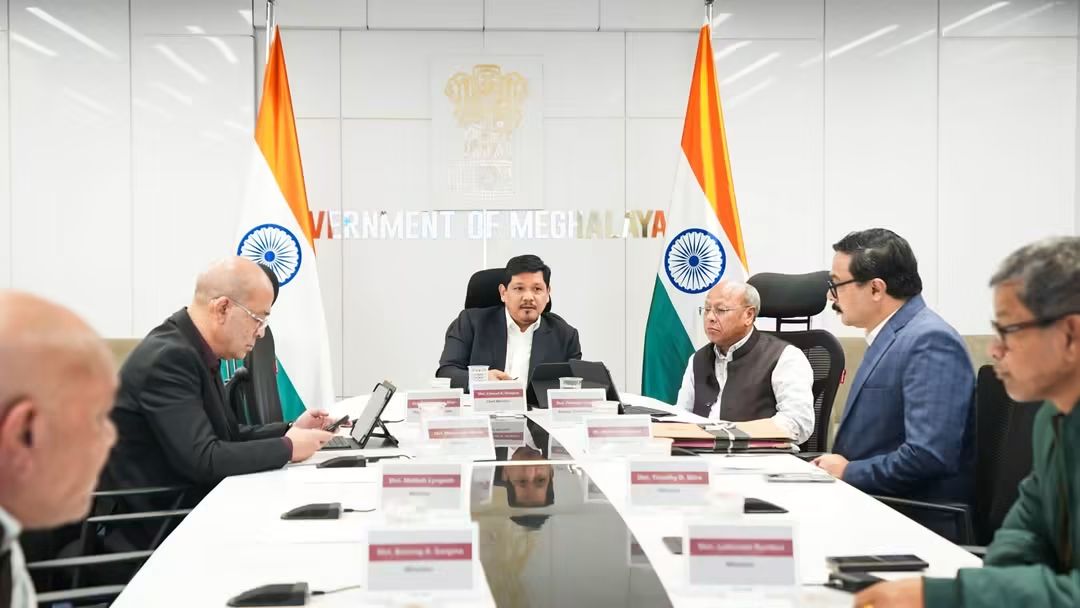

Meghalaya Conrad K. Sangma on Wednesday mounted a detailed defence of the state’s 1972 reservation policy, citing the exhaustive exercise undertaken by the Expert Committee on Reservation Policy and cautioning that any alteration to the existing framework could trigger adverse judicial consequences.
Replying to the Zero Hour Notice and Short Duration Discussion on the committee’s report during the ongoing Budget Session of the Meghalaya Legislative Assembly, Sangma said that, according to the report of the Expert Committee on Reservation Policy, the overwhelming majority of stakeholders favoured retaining the existing structure and warned that any substantial modification could expose the policy to judicial review.
“It is correct that the present system is in conflict with the judgement of Supreme court but at the same time it is protected by the same judgement, but this can be challenged before the court of law,” the Chief Minister said, acknowledging the legal tightrope the state continues to walk.
Referring to the landmark ruling in the Indra Sawhney v. Union of India case, he stated that the present policy “is not In consonance with a judgement of supreme court, specially in the case of Indra Sawhney where it caps the quantum of reservation to 50 percent when it is given on the basis of caste and community.” However, he emphasised that while the policy may appear to exceed the judicially evolved 50 per cent ceiling, it enjoys a degree of protection owing to its historical continuity of over five decades, thereby carrying a “lesser possibility of judicial review” than any newly crafted framework.
The Chief Minister said the expert committee had specifically cautioned stakeholders against pressing for changes to the 1972 policy, observing that such demands could adversely impact the current arrangement. “If the reservation policy could have would have to face the Touchstone of judicial review, this couldn’t succeed in the eyes of law,” he remarked.
The government had appointed retired justice Mool Chand Garg, former judge of the High Court of Madhya Pradesh, to head the expert panel in 2023. A search committee led by the Chief Secretary recommended the constitution of the Expert Committee on State Reservation Policy, which was formally notified on September 12, 2023. The committee was mandated to study the current reservation policy, recommend modifications if necessary, and undertake wide-ranging consultations with stakeholders across the state.
Initially given a 12-month timeframe, the panel’s tenure was extended in two phases — first for four months from September 13, 2024 to January 13, 2025, and subsequently until April 14, 2025. During deliberations between November 2023 and January 2025, the committee received around 1,024 communications, including letters, emails and representations, of which 547 were deemed substantial. Public hearings were held in Shillong, Tura, Williamnagar and Jowai, ensuring that no stakeholder was denied an opportunity to be heard. The report, structured in four parts spanning 21 volumes and 4,667 pages, was submitted on June 6, 2025 at Meghalaya House in New Delhi and received by Chief Secretary D.P. Wahlang.
Sangma said the Constitution does not prescribe a rigid numerical ceiling on reservations nor a definitive mechanism to determine their extent. However, judicial precedents — particularly from the Supreme Court — have evolved parameters including the 50 per cent ceiling principle.
Quoting from the Supreme Court’s observations, he said, “Though protection Clause Prohibits the states For making unreasonable discrimination in providing preferences and facilities for any section of its people, nonetheless, it requires the states to afford substantial equal opportunities to those placed unequally. The basic policy of reservation is to offset the inequality, and remove the manifest imbalance. The victims of which from bygone generation lags far behind and demand equity by special preferences and their Stretegy… It is more appropriate to recall that there is equality among equals and to equate unequals is Perpetuate inequality.”
He said the committee examined three core questions: whether the 85 per cent reservation for Scheduled Tribes is excessive; whether the distribution among tribal categories is proportionate to their backwardness; and whether any change is required in the present proportions.
On the first issue, he reiterated that while the 85 per cent quota may appear to conflict with the ceiling laid down in judicial precedents, it continues to be shielded to an extent due to its long-standing existence. On the second, he noted that mere population cannot be the sole criterion for determining reservation percentages, as repeatedly held by the Supreme Court. For analytical purposes, the state is often viewed in terms of Garo and non-Garo regions, but backwardness — not demographic strength — must remain the central determinant.
On the third question, Sangma said the majority of stakeholders opposed altering the 1972 framework. Only 15 representations suggested changes, with some advocating competition among the three major tribes and others proposing population-based allocation. However, the committee concluded that the philosophy of reservation is anchored in backwardness and compensatory justice rather than competitive parity.
“The majority of the stakeholders favoured retaining the 1972 policy that stands. The committee recommends retaining the 1972 reservation as it stands. Majority of the stakeholders support this view and any change would be vulnerable to judicial review. The committee also finds no compelling reason To modify the policy at this time,” he said, adding that improved implementation and stricter adherence could deliver better outcomes.
The debate was triggered by Opposition Voice of the People’s Party legislator Adelbert Nongrum, MLA from North Shillong, who moved a Zero Hour Notice under Rule 49A. Subsequently, VPP president and Nongkrem MLA Ardent Miller Basaiawmoit raised a Short Duration Discussion under Rule 50.
Earlier, Basaiawmoit had said, “I would like to remind this august House that when we asked the government to review, we were not asking to take away the rights of our Garo brothers and sisters. However, we are here to present the fact before the government and the need to review this policy…… I want to go forward and place on submission before the government so that we will understand why we raised this issue.”
He added, “We know that people of the khasi Jaintia hills region are not accepting this recommendation and indeed they are in great shock to see that the recommendation is to maintain the policy of 1972.”
Addressing apprehensions over judicial scrutiny, he said, “So sir, this is a legislature where law are made in legislative assembly, and in many cases we have come across that the judiciary hardly interfaces with the policy matter of the government. However, I would like to go to the original reservation policy adopted in 1972.”
“In the wake and backdrop of the decision of the court that we need to have a roster system, that is where the problem starts,” he said, adding that while the issue had reached court earlier, “the court did not question the policy, the court question the absence of roster in implementing the policy.”