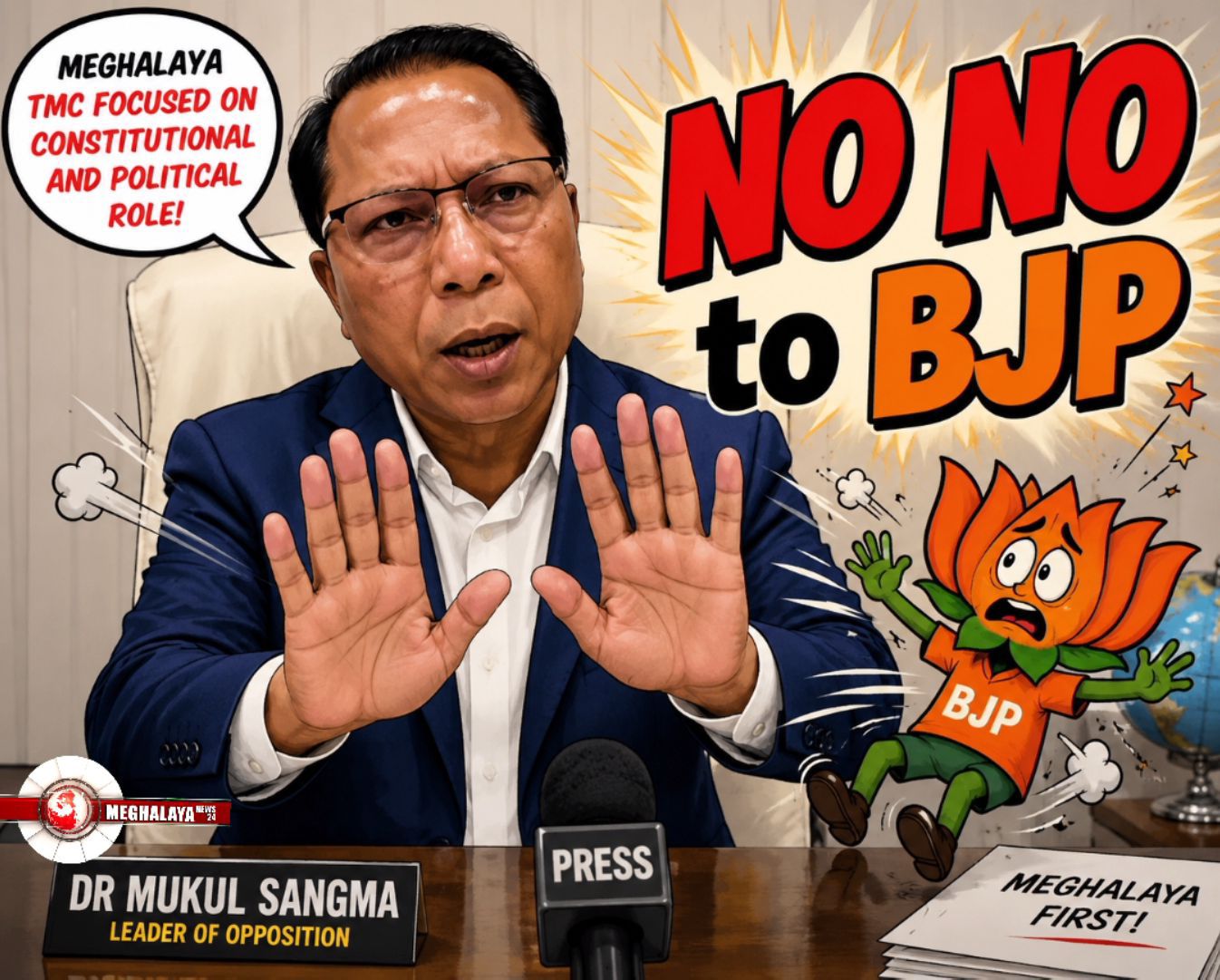
Meghalaya Leader of Opposition and former Chief Minister Mukul Sangma has ruled out joining the BJP or any other National political party, asserting that the BJP cannot break the Trinamool Congress (TMC) in Meghalaya even as the State witnesses heightened political churn. Indicating that the BJP might have approached him, Sangma declined to speak on the matter and said the BJP could not be ruled out from approaching more leaders. He also linked the political realignment to demands for the expeditious reopening of coal mines, describing such a connection as an illegal “quid pro quo”. “You cannot rule out BJP approaching many people, I don’t have to be specific to this answers I will respectfully say I will not answer this, even if they approach me also I will not tell you,” Sangma said.
Sangma, who is with the TMC, maintained that the BJP’s expansion plans would not automatically translate into a shift in the political loyalties of ordinary voters. “BJP cannot break us as far as Meghalaya is concern, so I will not comment,” Sangma said. He said political parties in Meghalaya need not be concerned about the BJP’s expansion strategy, arguing that it was the people at the grassroots who would ultimately decide the political future of the State rather than MLAs or party workers. “Political parties in Meghalaya need not be worried about BJP’s expansion plan because it is th people who will decide and not the MLAs, not their workers. Sometimes workers are the reason for MLAs to decide. It is not that when leaders go the common man at the grassroot also goes it doesnot happen in Meghalaya,” Sangma said.
Asked if the lotus was blooming in Meghalaya, Sangma said, “BJP thought it will bloom but it never bloomed. It is their desire,” Sangma said.
Sangma alleged that the prevailing political environment under the present dispensation lacked cohesiveness and inclusivity. “The prevailing environment in the present dispensation who are in the government is not cohesive not inclusive. something which was not there in the preceding decades,” Sangma said. Recalling his tenure as Chief Minister, he added, “During my time no selective release of funds,” Sangma said.
He alleged that legislators and leaders could switch political sides in expectation of political or financial benefits. “MLAs may go, leaders may go thinking of we go now we may get some financial benefit , when they are in power they want to weaponise their position to get something,” Sangma said.
Linking the political churn with demands for the expeditious reopening of coal mines, Sangma described the alleged arrangement as an illegal quid pro quo. “like they are saying they want to because we want to go because we want expeditious opening of the coal mines. that is the quick proco which is illegal,” Sangma said.
He also alleged that political poaching had affected senior leaders occupying top positions and stressed the importance of political integrity. “Many of the big leaders occupying top post are victim of the poaching. Integrity is the strongest weapon to fight against poaching,” Sangma said.
On the reported move by eight UDP MLAs to join the BJP, Sangma said the development was not sudden but reflected accumulated frustration within the ruling dispensation. “About eight UDP MLAs joining BJP, it is not something which unfolded suddenly , it was an element of surprise it would have happened other way also this whole development is approved beyond reasonable doubt the failure of the government , failure of the people in the government to create cohesiveness , to create environment of inclusivity,” Sangma said.
“Many of the MLAs were so frustrated that they were finding what to do and this is the result,” Sangma said.
He added that the developments reflected what he described as failures of governance and misplaced priorities within the ruling coalition. “That means the people who were in the government were victim of malgovernance. Mispriorities creating that environment where the sense of comfort and harmony starts evading, this is the outcome . It’s is still going on,” Sangma said.
Sangma said the BJP could have its own strategy to expand its political influence and was exploring different avenues. “BJP may have their own strategy and they are also exploring all means,” Sangma said. He said the statements made by the UDP legislators reflected the extent of their frustration and questioned whether the developments pointed to inadequate cohesiveness within the ruling coalition.
Sangma declined to name specific senior leaders whom he alleged were involved in political poaching, saying it would be unfortunate to identify individuals, but maintained that several leaders occupying top positions had themselves become victims of such political manoeuvring. “Many of the big leaders occupying top post are victim of the poaching. Integrity is the strongest weapon to fight against poaching,” Sangma said.
The political churn has intensified debate over the BJP’s expansion strategy in Meghalaya, particularly following the reported movement of eight UDP MLAs towards the party. Sangma, however, sought to distinguish between political realignments among legislators and the preferences of ordinary voters, maintaining that a leader’s decision to change parties did not mean the grassroots electorate would automatically follow.
Sangma’s position was that the BJP’s growing political activity could alter equations among leaders, but that the final choice remained with the people of Meghalaya. He maintained that the movement of MLAs or party workers could not by itself determine the political direction of the State.