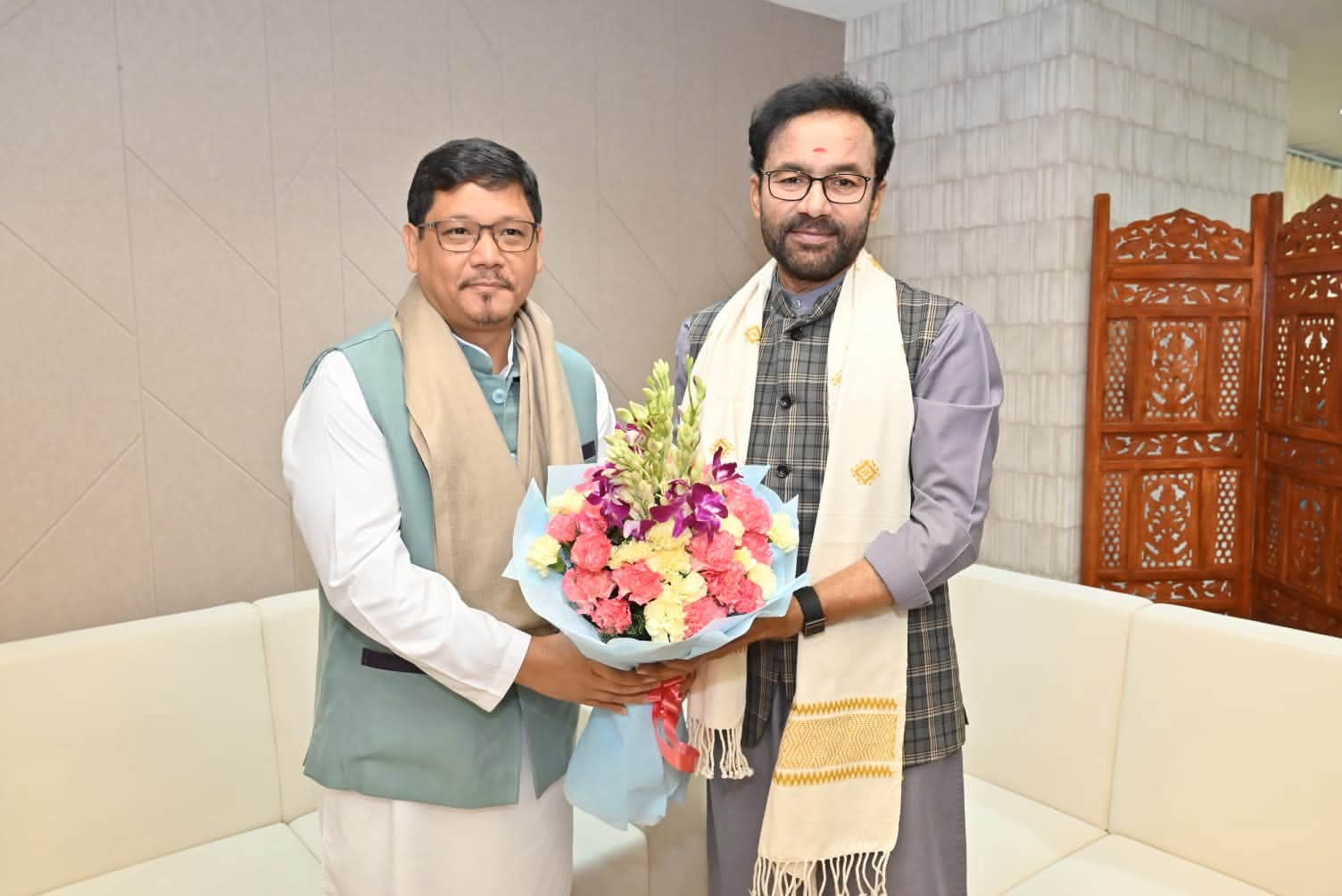
Meghalaya Chief Minister Conrad K. Sangma on Tuesday urged the Centre to delegate key statutory powers to the State for granting approvals related to coal mining, arguing that the existing system has left thousands of tribal coal-owning families without livelihoods while making legal mining virtually inaccessible.
Calling on Union Coal and Mines Minister G. Kishan Reddy in New Delhi, Sangma requested the Government of India to delegate to Meghalaya, under Section 26 of the Mines and Minerals (Development and Regulation) Act, 1957, the powers to grant previous approval and approve mining plans for coal. Sutnga-Saipung MLA Santa Mary Shylla accompanied the Chief Minister during the meeting.
The Chief Minister said the proposed delegation of powers would enable thousands of small tribal coal-holders to secure lawful mineral concessions and the required approvals within Meghalaya itself instead of approaching authorities outside the State.
Explaining Meghalaya’s unique constitutional position, Sangma said, “Meghalaya is a Sixth Schedule State where the land, and the minerals beneath it, belong to the individual, the clan or the community, and not to the State.” He pointed out that this position was affirmed by the Supreme Court in 2019, which recognised that tribals own both the land and the minerals while requiring compliance with the MMDR Act for mining operations.
He further stated that the State’s coal deposits differ significantly from those found elsewhere in the country, saying, “The State’s coal seams are thin and scattered, so coal is held in small family and clan parcels rather than in the large blocks found elsewhere in the country, and the national model therefore does not fit Meghalaya’s ground reality.”
Referring to the impact of the National Green Tribunal’s 2014 ban on rat-hole mining, Sangma said a large number of families dependent on small-scale coal mining had lost their livelihoods while the State also suffered a significant loss of revenue through royalty, cess and taxes.
He also highlighted that the minimum concession area of 100 hectares prescribed in the 2021 Standard Operating Procedure has effectively kept genuine tribal coal-holders out of the legal mining process because such contiguous land parcels rarely exist in Meghalaya and are seldom owned by a single individual. Sangma added that repeated travel to Delhi and the Indian Bureau of Mines office in Kolkata for approvals is neither practical nor affordable for small coal owners seeking permission to mine modest deposits.
Recalling that the Ministry of Coal had, in principle, agreed to Meghalaya’s request in 2015, the Chief Minister urged the Centre to issue the necessary notifications under Section 26 delegating these powers to the State along with the related powers under the Mineral Concession Rules, 1960, and the Mineral Conservation and Development Rules, 2017. A formal representation along with a detailed note outlining the State’s position and the specific powers sought was submitted to the Union Minister.
At the conclusion of the meeting, the Union Minister suggested that a committee be constituted to examine the matter. The Chief Minister welcomed the proposal, and a committee is expected to be formed shortly to take the issue forward.
Expressing gratitude to the Union Minister, Sangma voiced hope that the proposed measures would enable “thousands of families in the State to earn a lawful and dignified livelihood from their own mineral resources, under proper regulation and the close oversight of the State.”