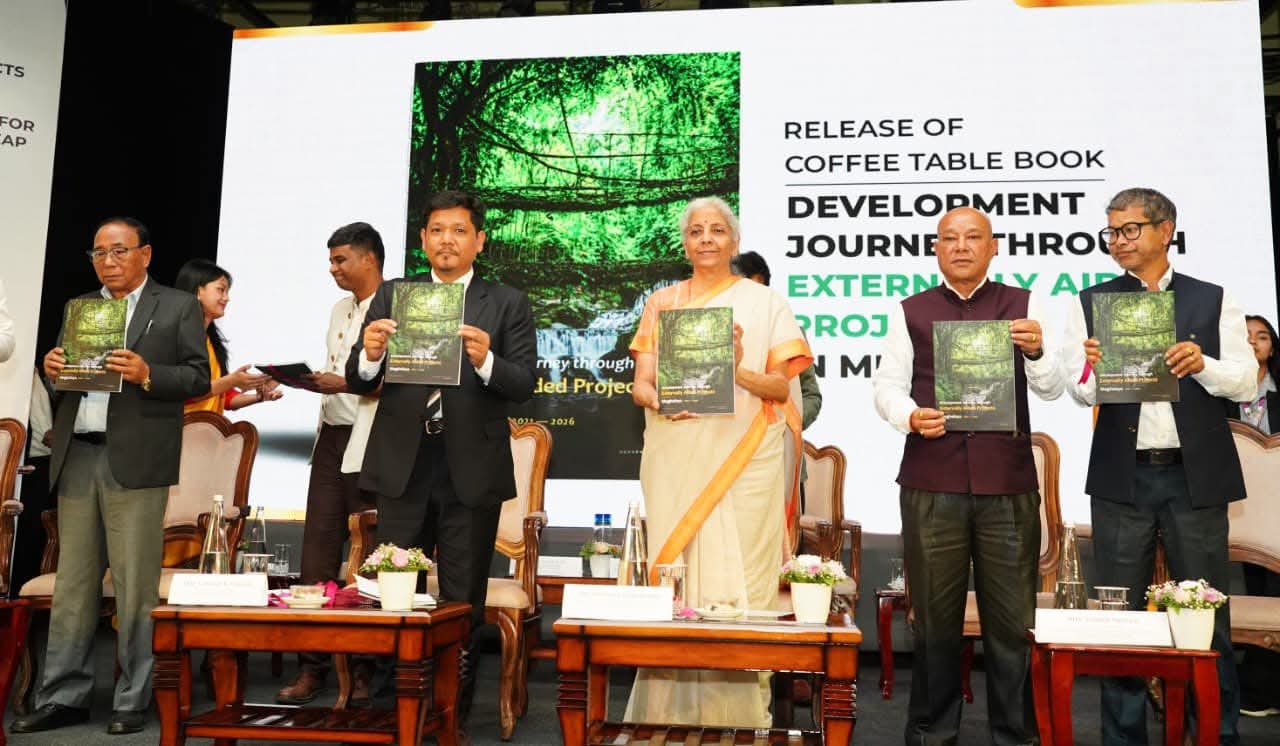
Union Finance and Corporate Affairs Minister Nirmala Sitharaman on Friday laid the foundation stone for Externally Aided Projects (EAPs) worth ₹1,246.74 crore in Meghalaya, while cautioning that persistent weaknesses in last-mile connectivity and patchy digital access in rural areas continue to hinder inclusive development. Stressing that infrastructure investments must translate into tangible economic opportunities, Sitharaman said many villages remain deprived of access to e-commerce and online education, underscoring the need for stronger maintenance frameworks, community ownership models and a life-cycle approach to infrastructure development. The projects, spanning logistics, education and eco-tourism, are aimed at strengthening connectivity and accelerating Meghalaya’s integration into national and global value chains.
Addressing a gathering at U Soso Tham Auditorium in Shillong, Sitharaman said the Meghalaya Logistics and Connectivity Improvement Project worth ₹957.46 crore would strengthen transport and connectivity infrastructure across the State. The Supporting Human Capital Development Project in Meghalaya Phase III, valued at ₹59.39 crore, will improve school infrastructure and educational outcomes, while the Integrated Eco-Tourism and Sustainable Development Project worth ₹138.39 crore will connect nature-based tourism with climate-resilient livelihoods. The Meghalaya Eco-Tourism Infrastructure Development Project, with an outlay of ₹91.60 crore, will focus on developing eco-tourism circuits.
Sitharaman said the projects reflected a comprehensive and future-oriented development strategy. “Meghalaya Government together with the community representatives for working together to come up with this kind of comprehensive futuristic program to help our people. This is where the externally Aided Projects becomes important, they are instrument to convert natural potential into economic opportunities. Local produce into National and global value chain and difficult terrain into connected corridor of economic growth.”
While acknowledging progress, she said implementation challenges continue to affect project delivery. “While we acknowledge progress, we must also recognises where we must do better. The pace of implementation remains uneven, due to difficult terrain, short construction season and procurement challenges. These obstacles are real but not insurmountable.”
Highlighting gaps in infrastructure and service delivery, Sitharaman said, “Private sector participation is limited in Tourism and logistics, the government alone cannot build and maintain every road way, hotel or coldchain. We must encourage public private partnerships with the transparent concessional framework and welcoming regulatory environment.” She added, “Last mile connectivity is a persistent weakness, digital connectivity remains patchy in many villages, denying people access to ecommerce and online education, maintenance contracts, community ownership model and life cycle approach to infrastructure are essential.”
Calling for better coordination among agencies, she said projects often operate in silos and stressed the need for unified project management platforms and interoperable databases to ensure seamless access to services and support across sectors.
Emphasising the broader significance of EAPs, Sitharaman said, “When we speak today about Externally Aided Projects in Meghalaya we are not speaking of loans of project cost, we are speaking of developmental model.” She added that the projects complement major infrastructure investments by targeting local socio-economic needs and bringing international best practices, innovative technologies and global expertise to the region.
The Minister noted that projects worth around ₹9,000 crore were sanctioned for the Northeast between 2004 and 2014, compared to nearly ₹76,000 crore between 2014 and 2026. “North East is no longer seen as periphery to India’s development story, it is been regarded as the central point to India’s growth, connectivity and future prosperity,” she said.
Sitharaman also underlined that the projects are being financed through borrowings undertaken by the Government of India and not by the State. “The central government is funding and supporting big ticket infrastructure across the region. Even as I am very happy in the way it is providing these facilities but because it is the borrowing of Government of India, CM is not borrowing, I am paying for it with happiness. People of Meghalaya this is something which is long overdue, your development, your connectivity, your entrepreneurship.”
Chief Minister Conrad K. Sangma thanked the Union Finance Minister for extending special support to Meghalaya, particularly by approving the Meghalaya Logistics and Connectivity Improvement Project beyond the prescribed ceiling. He said, “This support reflects the trust and commitment of the Government of India towards the development of Meghalaya and the Northeast.”
The programme was attended by members of the Meghalaya Cabinet and senior government officials.