By Rushoti Mukherjee
Streets Cleared. Promises Kept?
Something is missing from Khyndailad….
Not long ago, Shillong’s commercial heart pulsed with life. Hawkers called out to passing customers. Bargains were struck in seconds. The crowded pavements of Police Bazar carried a rhythm that generations grew up with. It was noisy. It was chaotic. It was alive.
Today, silence occupies much of that space.
Nearly a year after over two hundred hawkers were relocated from Khyndailad under ambitious pedestrianisation of Khyndailad project, the city centre looks very different. Vehicles without the requisite permit are no longer allowed to enter Khyndailad. Wider walkways have altered the character of the city’s commercial heart, while music now echoes through spaces where vendors once earned their livelihoods.
But beneath this apparent transformation lies a mystery that refuses to go away.
Where is the beautification that justified one of Shillong’s most significant urban interventions?
The hawkers were moved.
The streets were cleared.
Yet broken tiles continue to dot portions of the pedestrian zone.
Several stretches show visible signs of wear and deterioration.
Much of the promised makeover remains difficult to identify nearly a year after the relocation exercise began.
If the sacrifice was immediate, why do the benefits still appear unfinished?
And more importantly, what happened to the people who paid the price for that transformation?
The answers are not found on the pavements of Khyndailad,
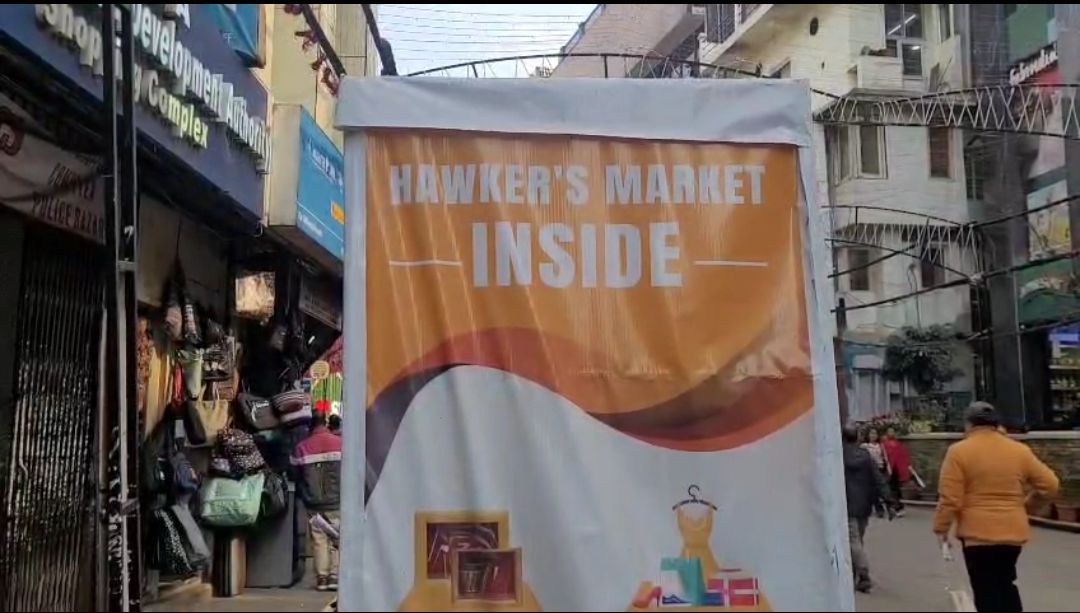
they are hidden inside the MUDA parking complex…..Behind rows of neatly arranged stalls, behind piles of unsold merchandise.
Behind the faces of vendors who once stood at the centre of Shillong’s busiest marketplace and now spend entire days waiting for customers who never arrive.
As cities across India pursue pedestrianisation, beautification and smart urban redevelopment projects, Shillong’s experience raises a question that extends far beyond Meghalaya.
When development changes the appearance of a city, does it also improve the lives of the people displaced by it?
Nearly one year later, many relocated hawkers say they are still waiting for that answer.
Market Hidden Behind Progress
Inside the MUDA parking complex, everything appears orderly.
Rows of stalls stand neatly aligned. Merchandise is carefully displayed. Pathways are organised and uncluttered.
At first glance, it resembles the future that planners envisioned.
Yet a closer look reveals something unsettling.
Customers are missing.
The bustling crowds that once sustained livelihoods in Khyndailad rarely find their way into the indoor market. Hawkers who once depended on the constant movement of people now spend much of their day watching empty corridors.
For many vendors, relocation did not simply change an address.
It changed the economics of survival.
The market exists.
The stalls exist.
The goods exist.
But the customers remain scarce.
Long Days Measured By Silence
Among those confronting this reality is 72-year-old Chandra Rani Arora.
Life has tested her resilience in ways few can imagine.
Having lost her husband and both her sons, she now faces the challenge of survival alone.
Every month brings obligations that cannot be postponed. A house rent of Rs 4,000. Transportation expenses. Daily household needs. Costs that continue whether customers arrive or not.
Seated behind stacks of neatly arranged garments, she waits patiently.
Often for hours.
Sometimes for entire days.
Without making a sale.
“We yearn even for a cup of tea,” Chandra shared, her voice reflecting the deep exhaustion of days that pass without a single sale.
The sentence is simple.
Its implications are profound.
Without access to a widow’s pension or ration card, she says the government’s one-time relocation grant of Rs 10,000 and temporary monthly stipends were insufficient to absorb the losses that followed.
The financial support ended.
The uncertainty remained.
Unseen Battle Outside Market Doors
For several vendors, poor footfall is only part of the problem.
Many allege that unauthorised vendors have gradually begun occupying portions of outdoor spaces around the area.
The consequence, they say, is devastating.
Customers who might otherwise enter the designated market often make purchases outside instead.
For vendors who complied with relocation orders and moved into organised stalls, the situation has created a growing sense of frustration.
Among them is Rupam Dhar, who spent more than twenty years selling winter wear on Shillong’s streets.
He says street vending depended heavily on visibility and impulse buying. The indoor market, by comparison, lacks the constant stream of potential customers that once kept businesses afloat.
For many vendors, the issue is no longer whether relocation happened.
It is whether the relocated market is receiving the support necessary to succeed.
One Cap. One Customer. One Entire Day.
Few stories capture the crisis as starkly as that of Biplu, who operates Stall 84 selling bags and caps.
Supporting his family and running his business requires nearly Rs 30,000 every month.
Yet some days produce almost no income.
Standing beside merchandise that remains untouched by customers, he points towards a single item.
“Since morning, I have sold only one piece, this cap.”
One cap.
One sale.
One entire day.
The words expose the fragile reality hidden behind dozens of stalls.
Every unsold item represents lost income.
Every empty hour represents uncertainty.
Every passing day raises new questions about sustainability.
Hope Refuses To Disappear
Despite overwhelming challenges, many hawkers continue to believe in the future.
Several vendors acknowledge that the government’s stall allocation process ahead of the National Games was fair and transparent. They appreciate being accommodated within the new system and believe the concept of an organised indoor market can eventually work.
What they seek is greater public awareness and stronger enforcement against unauthorised vending outside the complex.
For Rupam Dhar, optimism remains a necessity.
“Slowly, once everyone gets to know, then it will be fine.”
His words reflect a quiet determination shared by many vendors who continue to open their stalls each morning despite uncertain prospects.
Story Waiting For Final Chapter
Shillong’s hawker relocation is often discussed through the lens of urban development.
Wider walkways.
Pedestrian-friendly spaces.
Modern city planning.
Beautification.
Yet behind those narratives lies a story that is deeply human.
It is about elderly vendors who cannot afford retirement.
It is about families struggling to meet monthly expenses.
It is about workers who spent decades contributing to Shillong’s commercial identity and now wonder whether the city remembers them.
Nearly one year after relocation, Khyndailad’s familiar voices no longer echo through its streets.
But they have not disappeared.
They remain inside the MUDA parking complex.
Waiting.
Watching.
Hoping.
“Please come to this market in the MUDA parking lot and buy from us,” Biplu urged, hoping Shillong will not forget the faces that once brought life to its streets.
Perhaps that is where the real mystery of Shillong’s transformation lies.
The city succeeded in clearing its streets.
But can it fill its market?
Because if customers return, this story may eventually become one of resilience, adaptation and renewal.
If they do not, future generations may remember this transformation not for wider pavements or pedestrian zones, but for the livelihoods that quietly faded from public view.
Nearly one year later, the stalls remain open.
The hope remains alive.
And the story remains unfinished.