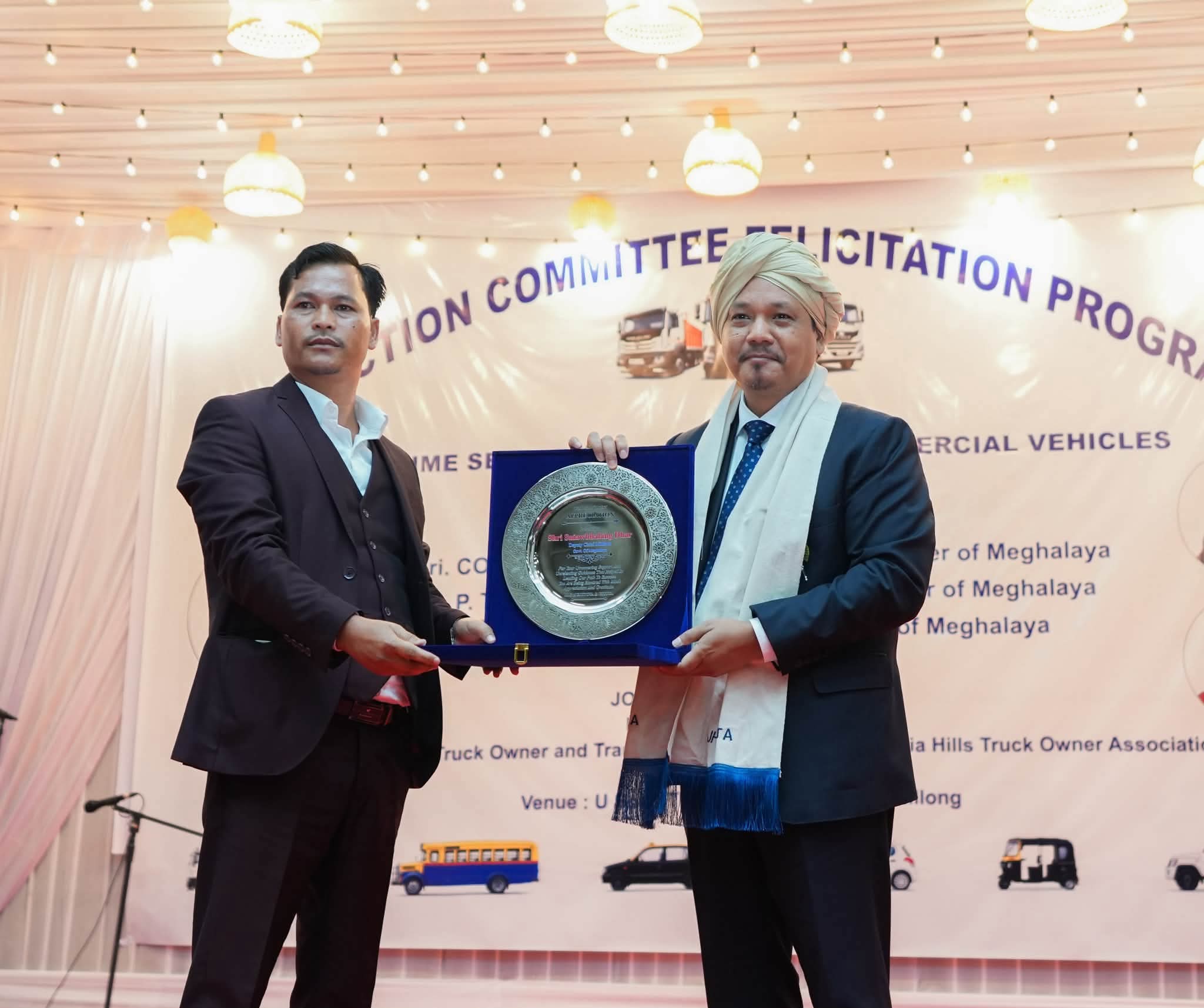
SHILLONG, July 1: Defending the Meghalaya government’s decision to waive nearly ₹850 crore to ₹1,000 crore in dues under the One Time Settlement (OTS) scheme for commercial vehicles, Chief Minister Conrad K. Sangma on Wednesday said the administration consciously chose to prioritise the welfare of nearly 16,000 truckers and their families—benefitting close to two lakh people—over revenue considerations, asserting that governance must ultimately be judged by the tangible impact it creates in the lives of citizens. Addressing a felicitation programme organised by the Joint Action Committee to acknowledge the government’s implementation of the OTS scheme, Sangma said the initiative reflected the State government’s philosophy of people-centric governance, where public welfare remains central to policymaking even as Meghalaya continues to pursue ambitious infrastructure development. During the programme, the organisers felicitated Sangma along with Deputy Chief Ministers Prestone Tynsong and Snaiwbhalang Dhar in recognition of their role in implementing the scheme.
Reflecting on the challenges of public life, Sangma said political leaders are often subjected to criticism when expectations are not fulfilled but rarely receive recognition when decisions positively transform people’s lives. “When there is a problem, politicians are seen as the biggest villains. But when solutions are delivered, very rarely are those efforts acknowledged. That is why this felicitation means a lot to us,” he said.
Emphasising that development extends far beyond physical infrastructure, the Chief Minister said governance must be measured by the difference it makes to ordinary citizens. “For us, development is not just about big roads, buildings, or stadiums. Every decision must translate into real impact in the lives of our people. That is the true measure of governance,” he said.
Describing the OTS scheme as one of the government’s most significant welfare-oriented interventions, Sangma said the decision required substantial fiscal sacrifice but was taken after recognising the severe burden borne by the transport community. “This was not an easy decision. That revenue could have been used elsewhere. But we realised that nearly 16,000 truckers and their families, almost two lakh people, were directly affected. We made this decision keeping them in mind,” he said.
Responding to criticism that the government is focused only on large infrastructure projects, Sangma said such assessments overlook the administration’s parallel commitment to addressing long-pending public concerns. “Yes, we are investing in big infrastructure. But we are equally committed to people-centric decisions, whether it is resolving long-pending issues of teachers, supporting farmers, or empowering entrepreneurs,” he said.
Stressing that lasting development requires a balance between transformational infrastructure and grassroots interventions, Sangma said, “Big projects send a message that Meghalaya is ready and capable. But the real success lies in how these initiatives improve everyday life,” he remarked.
The Chief Minister also acknowledged the role of Deputy Chief Minister Prestone Tynsong in championing the concerns of the transport community and bringing the proposal before the government. Calling for collective responsibility to ensure financial discipline and prevent similar backlogs in the future, Sangma assured that the government would continue strengthening institutional systems while placing citizens at the heart of governance. “We are not perfect, but we are committed to learning, improving, and keeping people at the centre of every decision. With the support of our citizens, we will continue moving Meghalaya forward,” he said.