
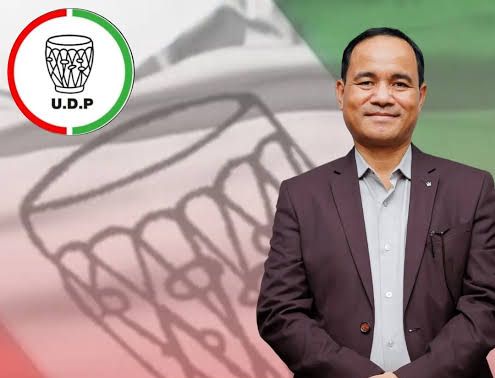
SHILLONG: Has the pursuit of regional unity reached a dead end in Meghalaya, prompting regional leaders to look towards a national party for political survival? Mawkyrwat legislator Renikton Lyngdoh Tongkhar, one of the three United Democratic Party (UDP) MLAs who have submitted a merger letter to Meghalaya Legislative Assembly Speaker Thomas A. Sangma to join the ruling National People’s Party (NPP), has cited the failure of efforts to unite regional parties and the growing support for the NPP in his constituency to explain his political move. His remarks underscore the shifting calculations within Meghalaya’s regional political landscape, where attempts to consolidate regional forces under a common platform have struggled to translate into a durable political alternative. With the UDP already weakened by the departure of eight of its 12 legislators to the Bharatiya Janata Party (BJP), Tongkhar’s proposed move to the NPP raises fresh questions about the future of regionalism and whether regional parties can retain their political relevance without consolidating their support base.
Explaining the ground realities in his constituency, Tongkhar pointed to the growing number of people from Mawkyrwat who have joined the NPP, suggesting that the political shift among his constituents had influenced his decision.
“As you have seen my people in Mawkyrwat in large number has already joined NPP,” Tongkhar said.
Asked about the prospects of unifying regional political parties in Meghalaya, the Mawkyrwat legislator said efforts had been made to bring them together under the Regional Democratic Alliance (RDA), but the initiative had failed to achieve its objective. He indicated that, in the absence of a viable regional consolidation, joining the NPP was now seen as the way forward to strengthen the political party he represented.
“You see we tried and we have done the best we can to unite the regional parties in the name of Regional Democratic Alliance we tried our best but you have seen we fail. Therefore we feel if we want to strengthen our political party which is the party led by our people then only chance is NPP,” he said.
Tongkhar’s remarks bring into focus the dilemma facing regional political formations in Meghalaya: whether to continue pursuing a united regional front or align with a larger political party to consolidate political influence. The failure of the RDA to bring regional parties together, as described by Tongkhar, appears to have reinforced his view that the NPP offers a more practical avenue for strengthening his political base.
The proposed move comes amid a wider realignment in Meghalaya politics, following the departure of eight UDP legislators to the BJP. The movement of three of the remaining UDP legislators towards the NPP could further diminish the party’s legislative presence and intensify the debate over the viability of regional political unity in the state.
For the UDP, the developments represent another challenge to its organisational strength. For Tongkhar, the stated rationale is rooted in the changing political preferences of his constituents and the failure of efforts to unite regional parties. Whether the shift towards the NPP strengthens the political representation of Mawkyrwat or further fragments Meghalaya’s regional political landscape remains to be seen. His move, however, has brought the debate over regionalism back into sharp focus, raising a fundamental question for the state’s political future: if regional parties cannot unite under a common platform, will their leaders increasingly look to national parties to secure their political footing?


