
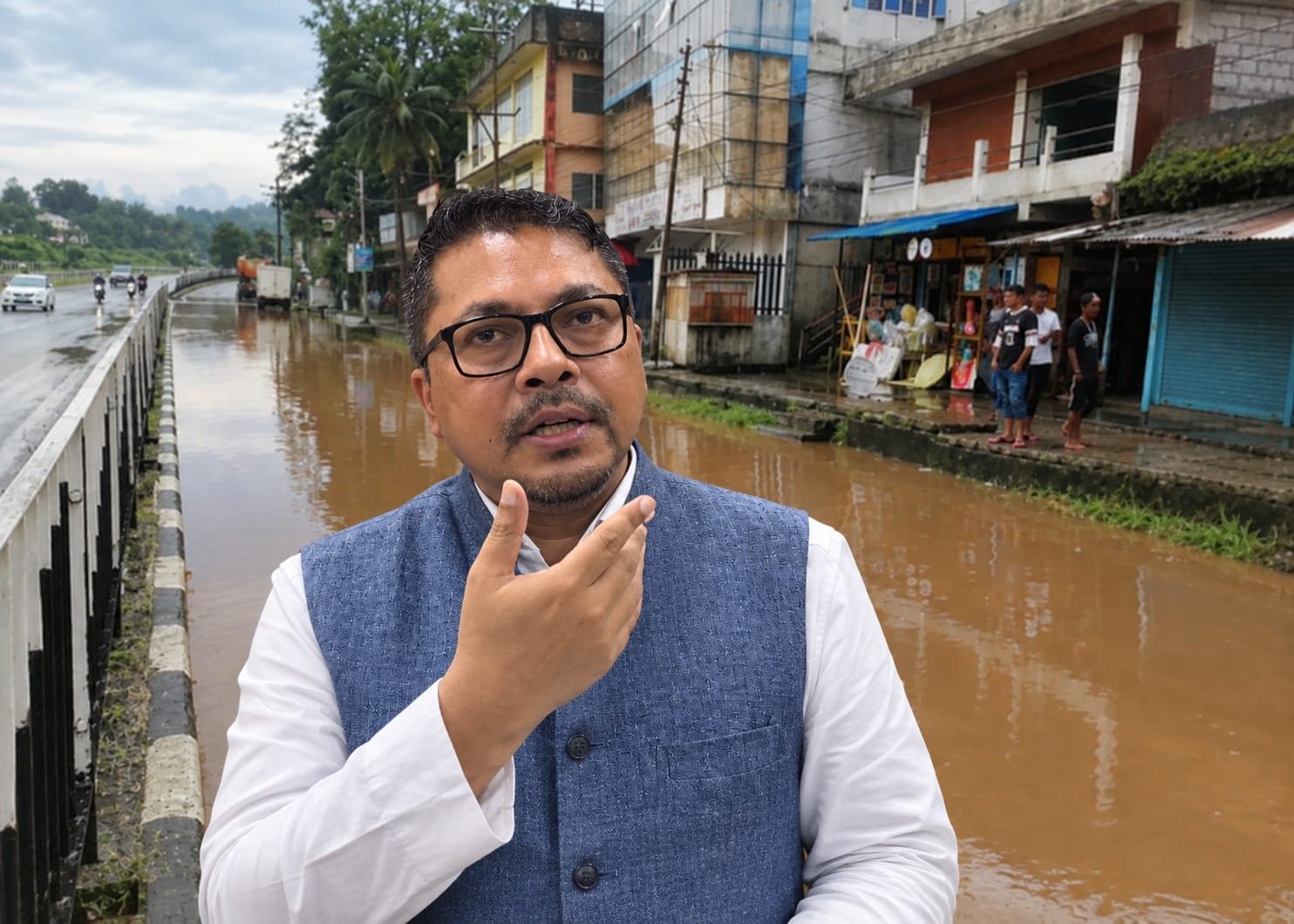
The recurring flooding and waterlogging in Meghalaya’s Ri Bhoi district has underlined the need for a coordinated policy response involving experts and multiple government departments, BJP MLA from Nongpoh Constituency Mayralborn Syiem has attributed the growing problem to a combination of changing monsoon patterns, climate change and human interventions, including unplanned earth-cutting and construction, that have reduced the capacity of natural drainage systems. He has called for all stakeholders to put their heads together, formulate a new policy and involve experts and various government departments in addressing the problem.
The issue has implications beyond Meghalaya, as rapid urbanisation, unplanned construction, encroachment or alteration of natural drains and inadequate drainage infrastructure have increasingly complicated the management of heavy rainfall in several Indian cities. Syiem said the response would require government departments to work together and reassess drainage infrastructure in areas experiencing rapid development and recurring flooding.
Syiem said changing environmental conditions and monsoon patterns over the past two to three years had intensified the challenge, with both climate change and human activity contributing to waterlogging and flooding.
He said construction of houses, commercial complexes and roads had progressively reduced the width and capacity of natural drains. He cited the example of a natural drain that was once about 15 feet wide but had been reduced to around seven and a half feet following development, leaving stormwater with fewer avenues to flow.
The MLA said the issue required coordination among the Department of Water Resources, PWD and Urban Affairs, particularly in Byrnihat, Nongpoh and Jorabat. “We have to concentrate on drains, the cross drain in the road, even the national highway,” he said.
He said existing cross-drainage structures also needed regular assessment and maintenance, particularly those built years ago. A structure constructed in 2010 could now be blocked, while increased rainfall and accumulated dirt and waste could further restrict its capacity, he said.
Syiem said the problem was the cumulative result of several factors, including changing rainfall patterns, urban expansion, construction activity, waste accumulation and inadequate drainage capacity. “Cities flooding is a common issue, it’s a concern for all,” he said, referring to flooding in Jorabat, Shillong, Nongpoh, Guwahati, Delhi and Bengaluru.
He said a comprehensive approach involving relevant departments, technical experts and regular assessment of drainage infrastructure was necessary to address the growing risk of urban flooding in Meghalaya.