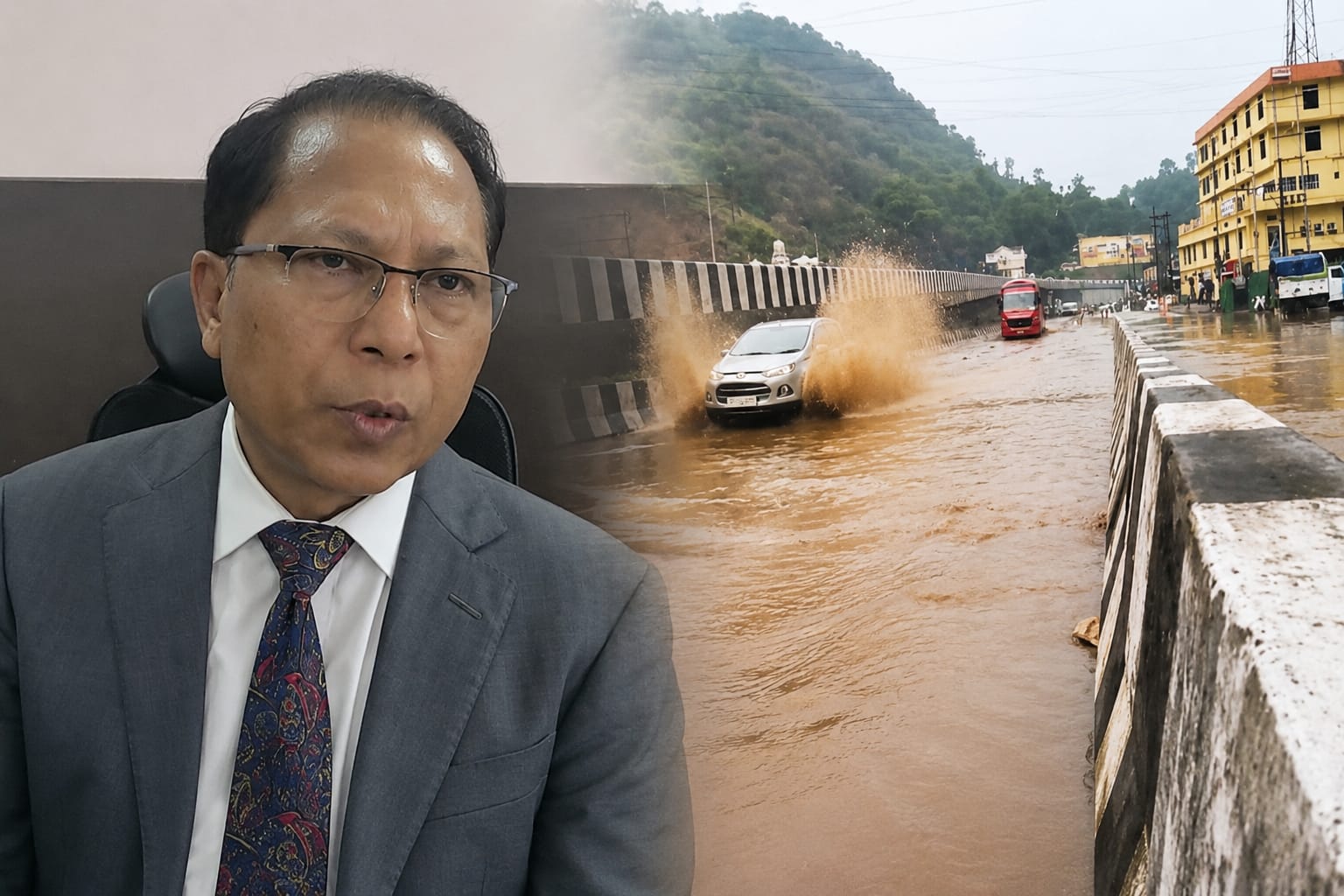
Leader of Opposition and former Chief Minister Dr Mukul Sangma on Tuesday criticised both the Assam and Meghalaya governments over persistent waterlogging along the Jorabat-Khanapara stretch, describing the situation as a serious road-safety concern and questioning the failure of authorities to address what he termed a structural problem caused by choked culverts and blocked water exits. He said the stretch, which serves as a crucial entry point to Guwahati and connects Meghalaya with Guwahati and its international airport, has repeatedly turned hazardous during heavy rain, leaving commuters and emergency vehicles stranded.
The leader of opposition said the responsibility cannot be shifted through a blame game between the two States when the affected stretch involves both Assam and Meghalaya and requires coordinated intervention by the concerned authorities.
“Unfortunately, this is what has been happening for last few years, And the only surprising part is that it continues, and as though it is nobody’s job to rectifier,” Dr Sangma said, adding that he had personally travelled through the area recently and sought to understand the factors behind the severe waterlogging and the risks posed to commuters.
“And it’s very dangerous from the road safety perspective it is binding on the authorities who Build a route who maintain the road who managed the road,” he said.
Dr Sangma said road safety is subject to institutional monitoring, including oversight arising from the Supreme Court’s interventions, and stressed that the concerned authorities are legally bound to comply with prescribed safety measures.
“There is Complete monitoring by the Supreme Court itself,” he said.
“You all are aware there is a Supreme Court committee on road safety, so different guidelines have been issued from time to time,” he said, stressing that compliance was required from all concerned authorities, including the Ministry of Road Transport and Highways, State Public Works Departments and the National Highways Authority of India wherever their jurisdictions are involved.
“And compliance is required to come from all the concern authorities and MoRTH is one of them, the authority, who are required to comply with, including State PWD, Wherever this National Highway NHAI, Morth and all Type of areas of concern, Which jeopardise road safety must be taken care,” Dr Sangma said.
The former CM said the consequences become particularly grave at night and during flooding, when information on the scale of disruption is not always available for public scrutiny. Recalling his recent experience on the stretch, he said he had witnessed several ambulances being caught in the congestion and waterlogging, raising concerns over the impact on patients requiring urgent medical attention.
“Now suppose in the night. What happens? You know, you have seen During the flooding Number of Informations which are not shared and therefore not available For public scrutiny. But then it is happening, and at the same time, the number of vehicles get carries patients, in critical conditions, that Day I saw quite a number of ambulances, they stuck,” he said.
Dr Sangma said the recurring nature of the problem points to a basic infrastructural failure rather than an isolated episode of flooding. He identified the choking of culverts and the obstruction of water outlets as the principal structural factors contributing to the waterlogging.
“So therefore, I think having seen this for such a long time, the cost, the attributing factor is nothing but structural, so this structural problem attributing to this problem is from the chocking of the culverts. Chocking of the exit of the water, you have the culverts water coming from one end, then it has to exit through the other end, but that exit point is chocked,” he said.
According to the TMC leader, once the designated drainage outlet is blocked, the highway itself effectively becomes the passage for accumulated water, creating a direct hazard for motorists and commuters.
“So, the exit point the road is becoming the exit point, now whose job it is to correct it, and why should not they correct it,” the Leader of opposition said.
He accused the authorities of failing to discharge their assigned responsibilities and said the issue could not be treated merely as an administrative inconvenience.
“Therefore, these are complete insensitivity towards the responsibility that is assigned. That is a legal responsibility because I would like to refresh everybody’s memory that there is a, Supreme Court committee on road safety,” Dr Sangma said.
He said the Supreme Court’s intervention on road safety was aimed at addressing the loss of precious lives on roads and ensuring that preventive measures are implemented by authorities at both the Union and State levels.
“This is based on Based on the Supreme Court taking cognizance of the road safety related issue. VIZ, the loss of precious lives and the prevention measures which can be put in place by all the authorities, including Union government and the state governments,” he said.
Dr Sangma further pointed to the commitments made by authorities through affidavits submitted before the Supreme Court, saying these commitments encompass not only prevention of accidents but also emergency response and treatment of victims.
“So, we are signatory to affidavits filed before the Supreme Court To ensure compliance of all those necessary interventions. Whatever is required for road safety measures, taking care of prevention and mitigating and dealing, including taking care of any victim of any road accidents, including, ensuring that there is a Immediate access to health care,” the leader of opposition said.
He said the principle of the “golden hour” — providing accident victims immediate access to emergency healthcare during the crucial first hour — forms part of the broader responsibility of the authorities.
“We refer to it as a golden hour, where the first hour, Which is met, available to the victim of the road accident can be provided in any nearest hospital, cashfree,” Dr Sangma said.
“These are binding Responsibilities of the authorities, both under the Union government and the state government and they must comply,” he added.
Dr Sangma called for coordinated action by the concerned agencies and said authorities should not remain passive while commuters are repeatedly exposed to danger and severe inconvenience.
“Therefore, it is only necessary that we have to press the concern authorities to see that they do not remain silent spectator and See that people are Subjected to this kind of danger and also inconvenience,” he said.
He also referred to the existing institutional mechanism for road safety, including district-level road safety committees and State road safety councils, and questioned why these bodies had not been able to resolve the recurring problem.
“There are committees. If you look at the Overall notification issued by the Committee which I have referred to constituted by the Supreme Court, There are Representatives from the MoRTH and also from various other authorities of the state government, where every district has the district road safety committee,” he said.
“Then you have every state where the state road safety council is there, which is chaired by the minister in charge of the Department of Transport,” he added.
Turning specifically to the Jorabat-Khanapara corridor, Dr Sangma said both Assam and Meghalaya have a responsibility to act in coordination, given the strategic importance of the stretch and its direct bearing on commuters travelling between the two States.
“So, therefore, they should see together and take organizations of this areas of concern and If you’re talking about that, very stretch between Jorabat to Khanapara, both the states are involved here, Meghalaya and Assam, so both the states has to ensure that they show some loyalty to their sense of responsibility in the best interest of the people,” he said.
He questioned how such a critical corridor could continue to suffer from chronic waterlogging despite being a major gateway to Guwahati and a key route for people travelling from Meghalaya and other parts of Assam.
“And can you imagine this is an entry points to Guwahati and this is the main road which connects us with Guwahati and Guwahati International Airport for all of the people coming from Upper Assam, Nogaon from Meghalaya,” Dr Sangma said.
Calling the continued neglect of the stretch unacceptable, he said authorities should focus on resolving the underlying problem instead of engaging in a blame game over whether activities on the Meghalaya side were contributing to flooding in Assam.
“It’s a shame that they don’t look at this area of concern, How much time it will take. Why have not they looked at rather than engaging in blame game, or it is because of the cutting of hills in Meghalaya that this side of the Assam part is affected by waterlogging, flooding,” he said.
“These are unnecessary, and then they must all understand their own respective responsibility,” Dr Sangma said.