

Exclusive
For years, Shillong’s narrow roads struggle under the growing burden of traffic congestion and indiscriminate roadside parking, turning routine commutes into daily ordeals for lakhs of residents and commuters. As the city’s vehicle population continues to rise, the challenge extends beyond traffic management to a larger question of civic responsibility.
Every day, the same familiar scenes unfold. Vehicles squeeze through narrow stretches. Pedestrians negotiate congested roads. Motorists search for parking spaces. A vehicle stopped for a few minutes can create a ripple of congestion that stretches far beyond the original obstruction.
But beneath the honking, hurried manoeuvres and rows of vehicles parked along roadsides, another problem is quietly taking shape—a gradual erosion of road discipline.
Now, Shillong is attempting something different.
Instead of beginning with fines, confrontation and punishment, the Shillong Traffic Police begins with a warning, a conversation and, in many cases, a second chance.
That experiment has a name—Operation Free Flow.
The campaign is not simply an attempt to remove illegally parked vehicles. It seeks to answer a deeper question: Can a city change its traffic habits without first changing the mindset of its motorists?
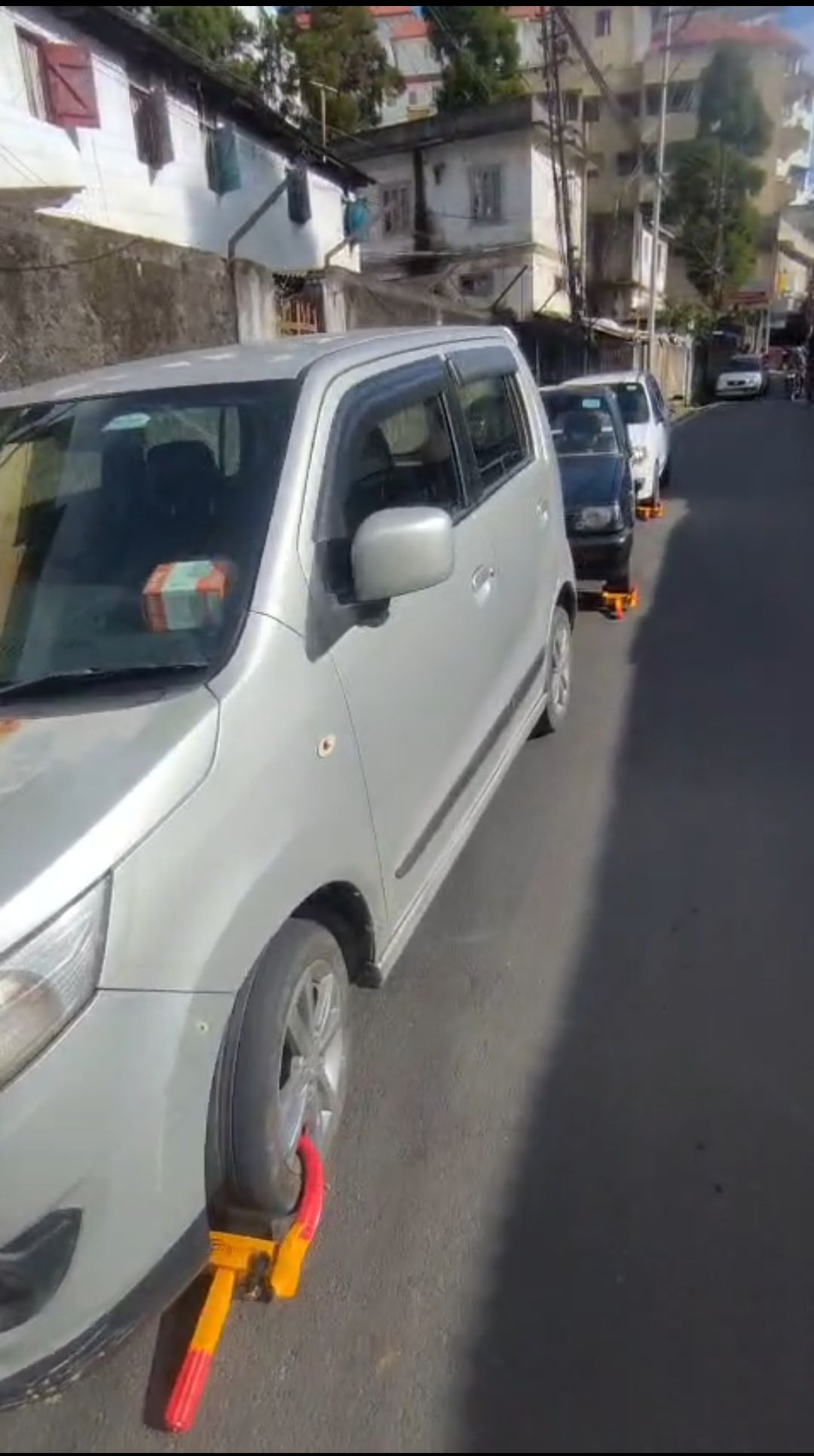
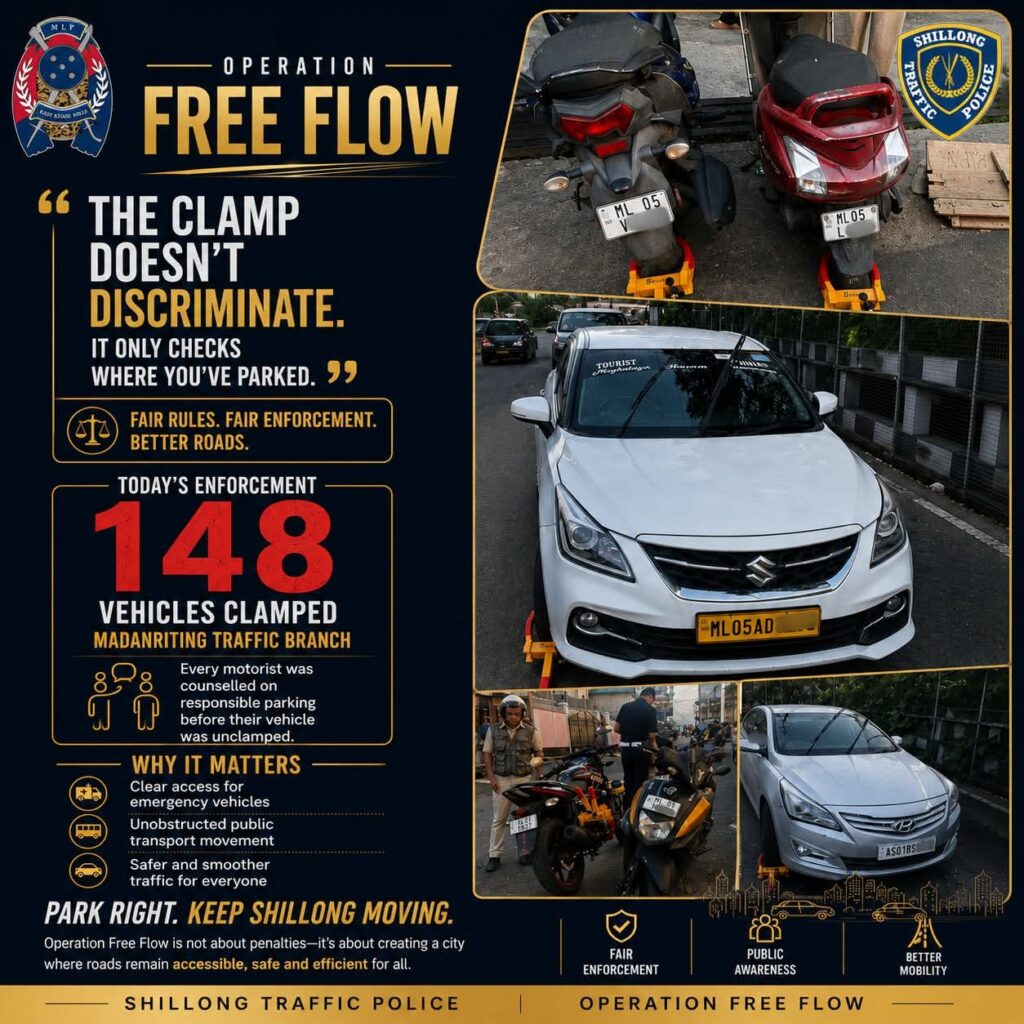
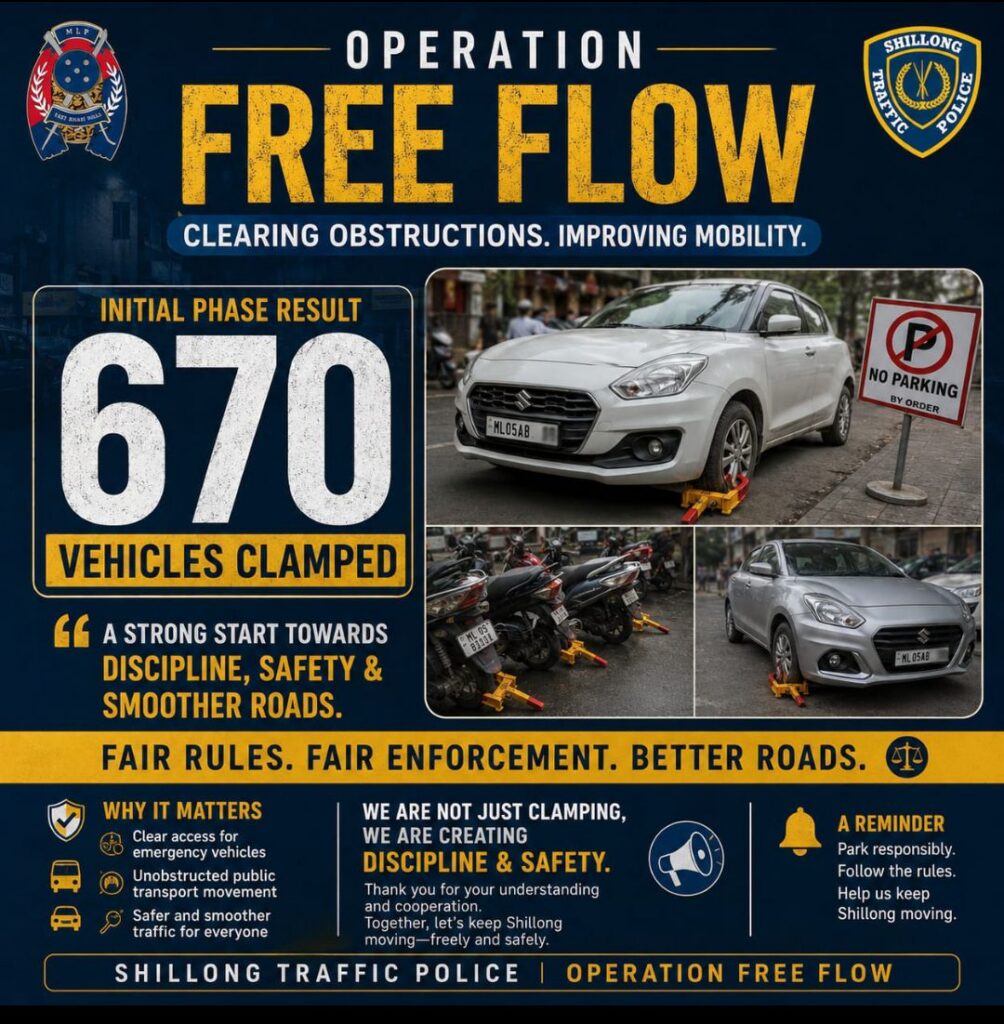
With nearly 670 vehicles already clamped during the first phase, the answer remains uncertain. But what makes the operation significant is not merely the number of vehicles caught. It is the philosophy behind the clamps.
The police are not initially asking motorists to pay for their mistakes.
They are asking them to understand them.
And somewhere between the first clamp and the possibility of a future fine lies the real battle—the battle for Shillong’s road culture.
From Enforcement to Behavioural Change
Superintendent of Traffic, Shillong, Dr Hari Prasanth MR, says the initiative is launched with a clear purpose: to keep traffic moving while making the city’s roads safer.
“This Operation Free Flow was formally launched in Shillong mainly focusing on unauthorized parking on the roadside. The major objective of this is to ensure free flow of traffic movement and to ensure safe roads,” he said.
The operation is deliberately structured as a gradual escalation rather than an overnight crackdown.
The first phase runs for 10 days and focuses on awareness. Vehicles found violating parking rules are clamped, but motorists are counselled and sensitised before their vehicles are released.
“The operation is planned in three phases. The first phase will be for 10 days and in the initial phase we just clamp the vehicles. We counsel the motorists and drivers, give them awareness and unclamp them. We don’t challan them. The first phase is for 10 days. We give them awareness,” he said.
It is a calculated opening move.
The second phase introduces penalties, while the third turns the focus towards repeat offenders.
“For the next 10 days, in phase two, we are planning to challan all of them. On the third phase, with repeat offenders, we are going to come strictly on them. We are going to challan them heavily and we are going to ensure that there is strict enforcement done in phase three,” Dr Hari Prasanth MR said.
The message is unmistakable: the first opportunity is education; the next is enforcement.
City Asked to Cooperate
Yet, Operation Free Flow is not being framed as a confrontation between motorists and the police.
Dr Hari Prasanth believes the public can become the strongest partner in the campaign when given the right guidance and facilitation.
“First thing is, we truly believe that people are with us and they want to follow all these things. Only thing is, they need some facilitation and from Shillong Traffic Police we are there to facilitate for that. We are firm on this as there will be strict enforcement,” he said.
That belief is crucial.
Traffic discipline cannot be created on the road alone. It has to begin at home, in schools, at workplaces and in everyday conversations about what constitutes responsible citizenship.
Nowhere is that more apparent than around educational institutions.
When Children Become Traffic Ambassadors
School zones are among Shillong’s most vulnerable traffic pressure points. During opening and closing hours, the movement of school buses, private vehicles, parents and pedestrians quickly puts additional pressure on already constrained roads.
The Traffic Police therefore brings schools directly into the campaign.
“We have mentioned which are the parking areas and which are not. We have formed traffic school committees where we have authorities from all schools, and we also have traffic personnel there, so we have a joint committee. This committee tries to bring awareness that there are areas where there should not be any parking. They are also bringing school ambassadors where school kids are being our ambassadors and take our information to their parents. Through school kids, we are reaching the parents, and we are working on that so that we could make sure that all the education zones would be made free flow of traffic, and these are our plans for the educational areas,” he said.
There is something quietly powerful about that strategy.
A police officer can issue a challan. A clamp can stop a vehicle. But a child asking a parent not to park where parking is prohibited creates a different kind of pause—one rooted not in fear, but in responsibility.
It turns traffic discipline from a policing issue into a civic lesson.
Real Target Are Not Vehicles
Behind the operation lies an ambition much larger than clearing a roadside.
The police want to change behaviour.
“The major objective of this operation was to bring about cultural change. It’s not just about enforcement, it is to bring about behavioural change among the motorists and for that behavioural change we needed to go phase-wise. These initial three phases are only the first step towards the cultural change, and it is only one of many things which we are doing. With all the things which we have planned, I think we could move towards a culture where there is responsible parking, where there are responsible motorists. We are trying to ensure that the roads are free and available only for the motorists. I know it is a long drawn process and it will take time, but we have started towards it.”
That admission—that it will take time—may be the most important part of the entire campaign.
Traffic habits built over years cannot disappear in a few days.
Operation Free Flow is therefore less a sudden crackdown than the opening chapter of a longer transformation.
Invisible Police Are Coming
For now, enforcement teams physically move through Shillong, identify violations and clamp vehicles.
But the future of traffic management is increasingly moving towards technology.
“In Operation Free Flow, we don’t use CCTV, but we are coming up with programmes and initiatives where CCTV will be involved. We have the Integrated Traffic Management System and we have the ICCC system. With all these things we are planning to come up where our CCTV cameras will act as virtual traffic police, where we could monitor our roads. For this operation we are not using CCTV. We are personally going and clamping vehicles,” he said.
The significance is difficult to miss.
The present operation is visible: a traffic officer, a clamp and a vehicle.
The future could be almost invisible: cameras watching intersections, identifying violations and creating a continuous digital layer of enforcement across the city.
But technology alone cannot solve a cultural problem.
A camera can detect an offence.
It cannot teach responsibility.
Hotspots Where Shillong Must Change
The Traffic Police has already identified critical areas where enforcement remains particularly strict.
“Few key traffic hotspots have been identified in Shillong city. In those hotspots we are very clear that there shouldn’t be any unauthorized parking. Regarding enforcement we are very strict in those hotspots. With regard to other areas, it’s more about bringing cultural change. Only when there is behavioural change it will last for long. In every sector we have found a few hotspot areas, which will be strictly monitored,” he said.
And this is where the campaign’s larger test begins.
Shillong’s roads cannot be transformed permanently by clamps alone. Nor can they be liberated by cameras alone.
The real change must happen in the moment when a motorist looks at an empty stretch of roadside and decides not to occupy it simply because there is no officer watching.
That is the moment when enforcement becomes culture.
Road Ahead
For decades, Shillong’s traffic story is written in familiar scenes—vehicles squeezed into narrow spaces, pedestrians negotiating congested roads and motorists searching for somewhere to stop.
Operation Free Flow attempts to write a different ending.
Its first phase is about awareness. Its second brings penalties. Its third promises tougher action against those who repeatedly refuse to change.
But the ultimate objective lies beyond all three.
It is the day when a motorist parks responsibly without seeing a traffic officer.
The day a parent chooses not to block a school gate.
The day a roadside remains clear because citizens understand that the road belongs to everyone.
Perhaps that is the real mystery unfolding behind Operation Free Flow.
The police begin by clamping vehicles, but the campaign is never truly about vehicles.
It is about habits.
It is about responsibility.
And, ultimately, it is about whether an entire city can decide to change.
Shillong’s roads remain narrow. Its traffic challenges remain deeply rooted. Its transformation may take years.
But every cultural change begins with one small decision.
For Shillong, that decision begins with a clamp, a conversation and a road finally left open.
The road to a more disciplined city may be long.
But Shillong is already clearing the way.


