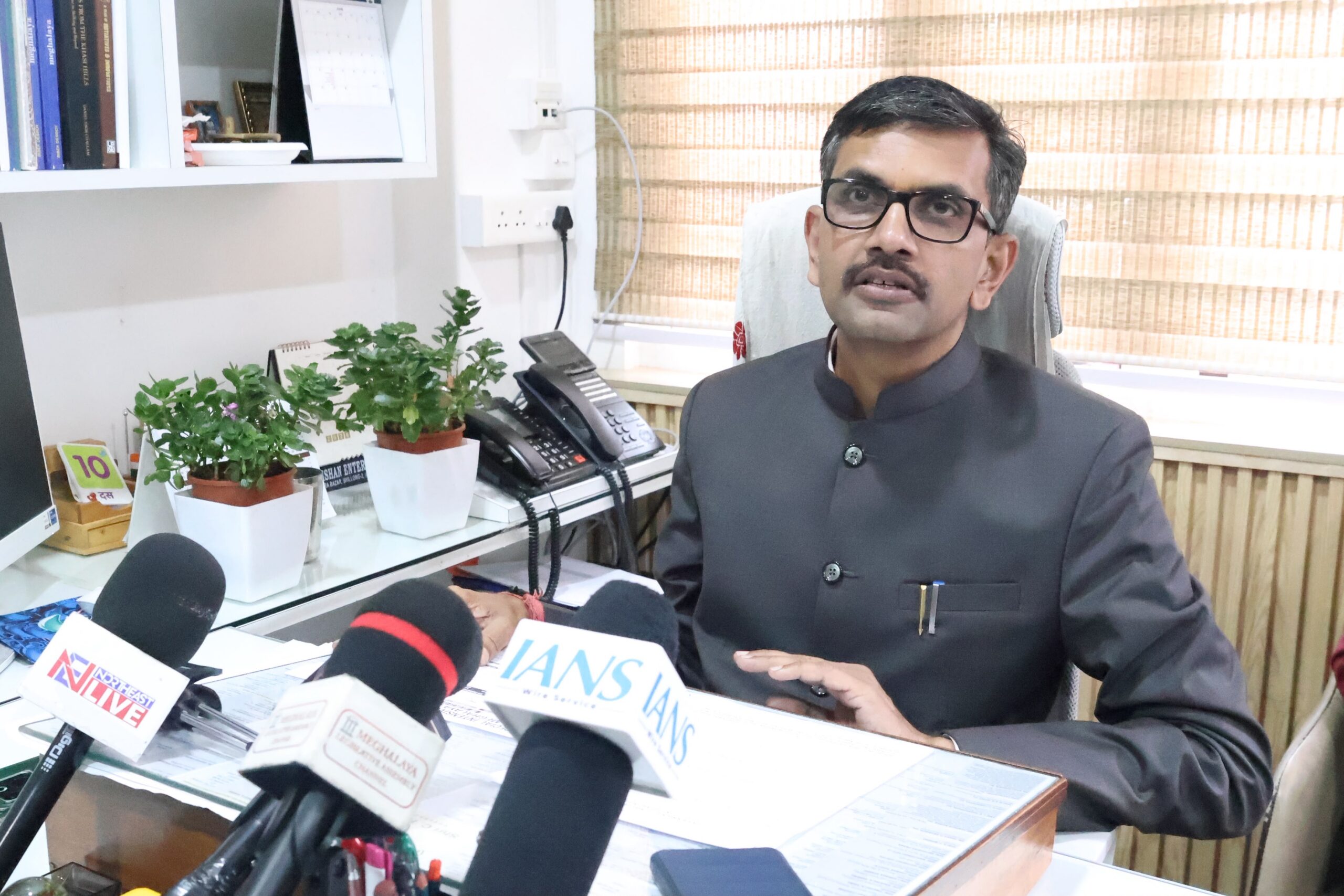
With Meghalaya’s Special Intensive Revision (SIR), 2026 entering its decisive final phase, the exercise has achieved 98.17 per cent distribution of Enumeration Forms (EFs), even as 323 electors have declined to accept the Enumeration Forms. The Chief Electoral Officer warned that electors who refuse to accept or fail to submit their duly filled Enumeration Forms within the prescribed timeline will not have their names included in the Draft Electoral Roll scheduled to be published on August 5. Dr BDR Tiwari also flagged poor network connectivity as a persistent challenge for Booth Level Officers (BLOs) in digitising and uploading the forms. During a review meeting with representatives of recognised national and state political parties in Shillong, it was noted that 892 Booth Level Agents (BLAs) have been appointed across Meghalaya’s 3,615 polling stations to support the Special Intensive Revision process.
As on July 21, 2026, Enumeration Forms have been distributed to 23,06,585 electors out of the State’s total electorate of 23,49,645, taking the overall distribution to 98.17 per cent. Simultaneously, 14,07,446 Enumeration Forms have been digitised, accounting for 62.15 per cent of the total electorate.
West Jaintia Hills, South West Khasi Hills and South West Garo Hills have achieved 100 per cent Enumeration Form distribution, followed by East Garo Hills with 99.93 per cent and Ri-Bhoi with 99.80 per cent.
In the digitisation process, West Khasi Hills leads with 79.86 per cent, followed by South West Khasi Hills at 78.51 per cent, East Jaintia Hills at 75.44 per cent, West Garo Hills at 74.03 per cent and South West Garo Hills at 73.81 per cent.
The Chief Electoral Officer further found that 53,908 electors, constituting 2.29 per cent of the State’s electorate, have been identified under the Absentee, Shifted, Death and Duplicate (ASDD) categories. Of these, 5,795 electors have been identified as absent, 13,379 as shifted, 32,382 as deceased, 2,029 as duplicate, while 323 electors refused to accept the Enumeration Forms.
The Office of the Chief Electoral Officer said, “These cases will be dealt with in accordance with the provisions of the Registration of Electors Rules, 1960, after following the prescribed verification process and providing due opportunity to the concerned electors wherever applicable, before any decision is taken regarding the electoral roll.”
Reiterating the consequences of non-compliance, the Office of the Chief Electoral Officer stated, “Electors who do not submit their duly filled Enumeration Forms within the prescribed timeline will not have their names included in the Draft Electoral Roll scheduled to be published on 5th August, 2026 and will be displayed in all the Polling Stations.”
Eligible electors have been advised to submit their duly filled Enumeration Forms to their respective Booth Level Officers or through the online mode by downloading the ECINET App or visiting the Election Commission’s voter portal well before the deadline to facilitate their inclusion in the Draft Electoral Roll.
To ensure timely completion of the Special Intensive Revision, the Chief Electoral Officer has been conducting weekly video conferences with District Election Officers (DEOs), Electoral Registration Officers (EROs) and Assistant Electoral Registration Officers (AEROs). The review meetings are focused on monitoring the progress of house-to-house distribution and collection of Enumeration Forms, digitisation of Enumeration Forms and other SIR-related activities. District election authorities have also been directed to closely supervise the work of Booth Level Officers, promptly address field-level issues, including network-related challenges, and ensure that all activities are completed within the timeline prescribed by the Election Commission of India.
During the meeting with recognised national and state political parties, the Chief Electoral Officer appreciated their active participation and acknowledged the appointment of 892 Booth Level Agents across the State.
The Office of the Chief Electoral Officer said, “The BLAs are expected to play a vital role in assisting electors, verifying electoral roll details and ensuring greater transparency and accuracy in the Special Intensive Revision process.”
The Chief Electoral Officer also urged all political parties to continue extending their cooperation for the timely and successful completion of the SIR exercise.
The Office of the Chief Electoral Officer commended the dedicated efforts of the District Election Officers, Electoral Registration Officers, Assistant Electoral Registration Officers, Booth Level Officers, BLO Supervisors and all officials associated with the Special Intensive Revision for achieving the present level of progress.
Appealing to electors yet to complete the process, the Office of the Chief Electoral Officer requested those who have not received or submitted their Enumeration Forms to cooperate with Booth Level Officers during house-to-house visits or seek assistance from their respective BLOs. Reiterating the objective of the exercise, the Office of the Chief Electoral Officer appealed to all eligible electors to actively participate in the Special Intensive Revision, 2026 and ensure that every eligible citizen is included in the Electoral Roll, thereby strengthening free, fair, inclusive and participative elections.


